

Narrow Margins. Giant Stakes.
 Spain
Spain
 Belgium
Spain vs Belgium Prediction
Spain vs Belgium at Los Angeles Stadium is a quarter-final collision between two European heavyweights with opposite instincts. Spain want to own the ball, dictate rhythm and suffocate opponents through circulation; Belgium want to absorb, spring forward and let Kevin De Bruyne rewrite the geometry of a match in a single pass.
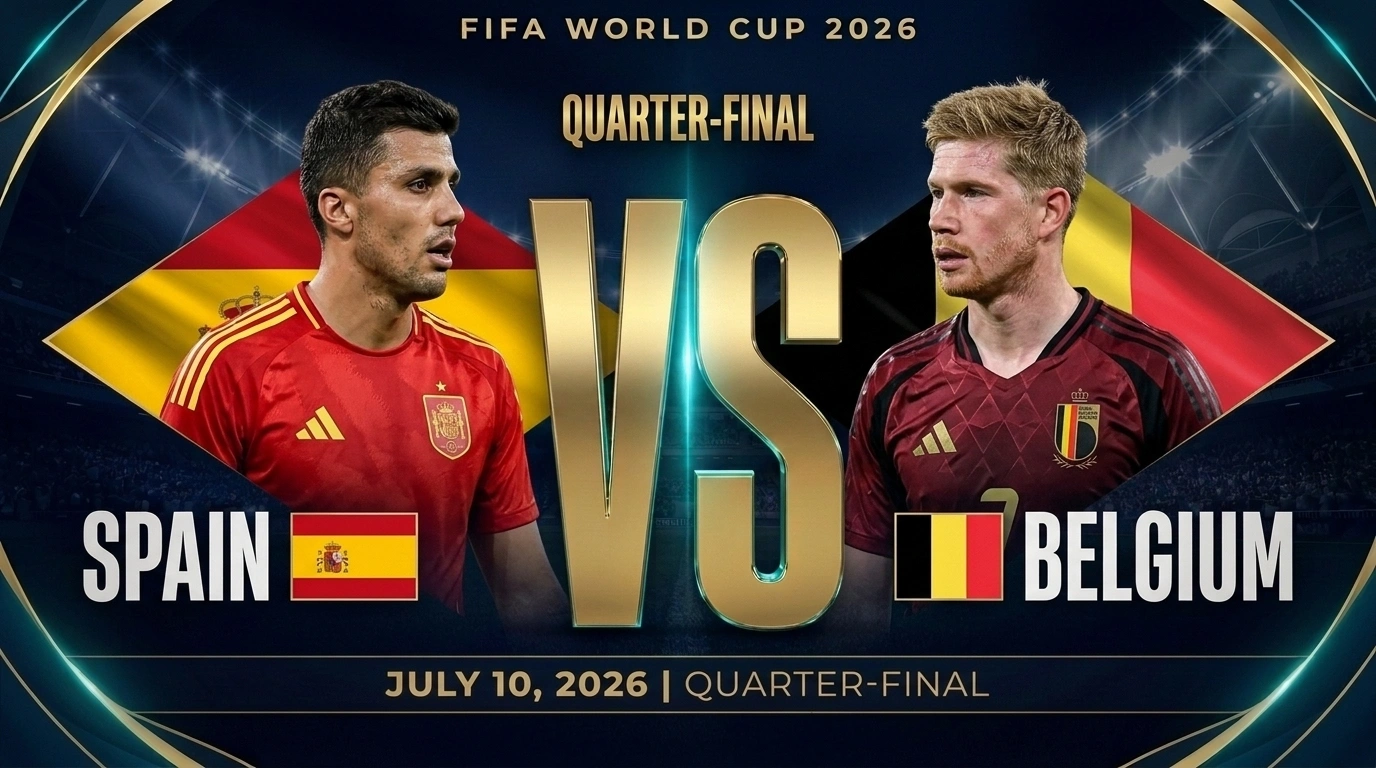
Spain vs Belgium Quarter-final Details
Why This Quarter-final Matters
Quarter-finals are where tournament narratives harden into history. Spain arrive in Inglewood carrying the weight of a generation that has redefined what Spanish football looks like: younger, faster, more vertical than the tiki-taka stereotype, but still rooted in the belief that controlling the ball is the most reliable way to control outcomes. Belgium arrive with a different kind of pressure — the sense that this golden generation, led by De Bruyne and Romelu Lukaku, may be running out of time to convert individual brilliance into the one trophy that has always eluded them.
The stakes extend beyond a single 90-minute contest. FIFA's official bracket routes the Spain vs Belgium winner into the first semi-final in Dallas on July 14, where they will face whichever side emerges from France vs Morocco in Boston. That means the winner of this tie is potentially two games from a World Cup final on North American soil — a prize that would rewrite the legacy of either squad.
On the pitch, the tactical contrast could hardly be sharper. Spain's tournament profile has been built on control, patient circulation and wide acceleration through Lamine Yamal, with Álvaro Morata providing movement inside the box. Belgium's profile is different: less about long possession phases and more about transition quality, De Bruyne's vision, Doku's dribbling and Lukaku's physical presence as a focal point.
For anyone searching for a Spain vs Belgium prediction, preview, betting tips or expected lineups, the essential insight is that this is not a mismatch. Spain are favoured because their structural control gives them more ways to win, but Belgium have already demonstrated in this tournament — most vividly in a 4–1 demolition of the USA in the Round of 16 — that they can punish teams who overcommit in possession. The quarter-final will be decided by whether Spain can maintain their composure when Belgium's transitions arrive, and whether Belgium can survive the sustained territorial pressure that has defined every Spanish knockout run so far.
Los Angeles Stadium adds another layer. The venue in Inglewood, California, will host one of the most tactically sophisticated quarter-finals of the entire tournament, in front of a crowd that understands both European football culture and the Hollywood-scale spectacle of a World Cup knockout match. The afternoon kickoff at 3:00 PM ET means warm conditions and a fast surface — factors that could favour Spain's technical superiority in the first hour, but also accelerate fatigue for a Belgium side that may need to cover significant ground without the ball.
How Spain and Belgium Reached the Last Eight
Spain: possession as a knockout weapon
Group stage: Spain navigated a demanding group without losing their identity. FIFA match reports throughout the tournament have framed Spain as a team built around control, technical rhythm and defensive stability. Their group-stage performances combined patient circulation with faster wide attacks, and they rarely looked rattled when opponents tried to press high.
Round of 32: The first knockout test asked Spain to manage a game they were expected to dominate. They did exactly that: patient build-up, selective acceleration in the final third, and a defensive structure that recovered quickly when turnovers occurred. The scoreline was comfortable without being extravagant — a sign that Luis de la Fuente's side understands how to win without needing to prove a point.
Round of 16 vs Portugal: A 1–0 victory that will be remembered as much for what it represented as for how it was played. Iberian derbies at World Cups are rarely open affairs, and this one followed the pattern: Spain controlled territory, Portugal threatened on transitions, and a single moment of quality decided it. Spain's territorial control was clear, even if their finishing left room for late anxiety.
Spain's arc through the tournament has been one of increasing authority. The group stage established their technical ceiling; the knockout rounds have shown they can narrow their focus when margins shrink. That combination — flair when the game allows it, pragmatism when it demands it — is precisely the profile you want heading into a quarter-final against a counter-attacking specialist.
Belgium: counters, creativity and conviction
Group stage: Belgium's campaign opened with the measured caution of a team that knows knockout football rewards patience. They were not the highest-possession side in their group, but they were among the most efficient: fewer long possession phases, but quicker attacks when space opened. De Bruyne's influence grew with each matchday as fitness and sharpness aligned.
Round of 32: Belgium faced a fixture where they were content to let the opponent chase the game. Their defensive line sat deeper than Spain's typically does, the midfield screened central corridors, and the front three stayed connected for rapid vertical breaks. When the opponent's structure cracked — and in knockout football, structures always crack eventually — Belgium punished them with direct, high-quality attacks.
Round of 16 vs USA: The 4–1 scoreline was the statement performance of Belgium's tournament. Against an American side that pressed aggressively and committed numbers forward, Belgium's transition game reached its peak: Doku tormented full-backs one-on-one, De Bruyne supplied passes that bypassed entire defensive lines, and Lukaku provided the physical anchor that turned half-chances into clear opportunities. The match summary matched the eye test: Belgium repeatedly turned American pressure into clear transition chances.
Belgium's road to Inglewood has been defined by one principle: you do not need the ball to control the match if you control the moments that matter. They arrive at the quarter-final as a team that believes its best weapon is the space behind possession-heavy opponents — and Spain are the most possession-heavy team left in their half of the bracket.
Spain vs Belgium: Tournament Stats Snapshot
This section combines official match context with editorial trend analysis. Where advanced metrics such as expected goals are discussed, they should be read as directional profiles rather than official figures.
How Spain and Belgium Match Up Tactically
Spain: positional control and progressive width
Spain's build-up is built around a back four that morphs into a three-man first line when one full-back pushes high and the opposite centre-back shifts wide to cover. Rodri — or Spain's designated holding midfielder — anchors the base, while Pedri and another interior midfielder operate in the half-spaces, receiving between lines and linking play toward the wide zones where Yamal and the opposite winger stretch the pitch.
The defining feature of Spain's possession game in this tournament has been its purpose. This is not circulation for its own sake. Every pass sequence is designed to either draw a Belgian defender out of position or create an overload on one flank. When Yamal receives one-on-one against a full-back, Spain's midfielders have already positioned themselves to recycle the ball quickly if the initial attack stalls — ensuring that a failed dribble does not become a Belgian counter.
Spain's pressing is coordinated and aggressive in the first phase. They look to force turnovers in Belgium's defensive third, particularly when Belgian centre-backs receive under pressure from Morata's screening runs. If Spain score first, expect them to maintain possession rhythms rather than sitting deep — their coaching staff trusts the structure to limit counter-attacking opportunities even when both full-backs are advanced.
The vulnerability, when it surfaces, is in the seconds immediately after a turnover in advanced positions. If Pedri or the advanced full-back loses the ball in Belgium's half, the space behind Spain's midfield line becomes exploitable. De Bruyne has built a career on identifying exactly that type of moment, and Doku has the acceleration to punish it before Spain's shape resets.
Belgium: compact block, De Bruyne as the release valve
Belgium's out-of-possession shape typically settles into a 4–4–2 or 4–4–1–1 mid-block, with Lukaku and a supporting forward cutting passing lanes into midfield while the wide midfielders tuck in to protect the half-spaces. The back four stays compact, rarely stepping into challenges they cannot win, and the priority is always the same: deny Pedri and Rodri the easy progression pass, then win the ball and get it to De Bruyne as quickly as possible.
De Bruyne's role in this system is not simply creative — it is structural. He is the player who turns Belgium's defensive phases into attacking ones, often with a single pass that bypasses three or four Spanish players. His ability to hit diagonals into Doku's channel, clip balls over the top for Lukaku's runs, or drive forward himself when space opens gives Belgium a multi-dimensional counter threat that few teams in the tournament can replicate.
Doku's dribbling adds a different dimension. Against the USA, his ability to carry the ball at speed forced defenders to commit, which in turn created the gaps that De Bruyne and Lukaku exploited. Against Spain, Doku's matchup against Spain's advanced full-backs will be one of the most important individual battles of the quarter-final. If he wins it consistently, Belgium's counter-attacking model functions at full capacity.
Belgium's trade-off is clear: they accept long periods without the ball, trusting their organisation and De Bruyne's genius to produce two or three high-quality chances. The risk is cumulative fatigue and set-piece pressure — Spain's corner count and final-third entries will test Belgium's concentration over 90 minutes, and even elite blocks eventually concede when the volume is high enough.
Coaching philosophies and likely in-game adjustments
Luis de la Fuente has shown flexibility within Spain's possession framework. If Belgium's block is denying central penetration, Spain can shift to wider overloads with both full-backs pushing high, or introduce a more direct striker to attack crosses. He may also adjust the pressing trigger — sitting slightly deeper after the 60th minute to protect against De Bruyne's counter passes if Spain hold a lead.
Belgium's coaching staff, meanwhile, face the challenge of calibrating their defensive line height. Too deep, and Spain will pin them in their own half with endless circulation. Too high, and Morata's runs in behind become dangerous. The likely compromise is a mid-block that steps aggressively when the ball is wide but drops quickly when Pedri receives in central space. Substitutions will probably focus on fresh legs for the wide counter-attacking roles — preserving Doku's explosiveness for the moments when Spain are most stretched.
Key Individual Battles
Pedri vs De Bruyne: control vs creativity
The central duel that defines the match's tactical narrative. Pedri's job is to keep Spain's possession machine running — finding angles, recycling play, and dictating tempo from deep. De Bruyne's job is the opposite: intercept, receive, and transform defence into attack with passes that no scouting report can fully prepare for. Whichever midfielder imposes their rhythm more consistently will tilt the quarter-final.
Yamal vs Belgium's left-sided defender
Lamine Yamal has been Spain's most dangerous wide outlet in this tournament, combining dribbling skill with an increasingly mature decision-making profile. Belgium's left-back — likely facing Yamal one-on-one repeatedly — must decide between showing him inside into traffic or forcing him wide and risking quality crosses. If Yamal wins this matchup, Spain's possession becomes genuinely threatening rather than merely territorial.
Doku vs Spain's right-back
The mirror image on Belgium's attacking transitions. Doku's pace and close control make him one of the most difficult players to defend in one-on-one situations, especially when he has a running start on the counter. Spain's right-sided defender must balance supporting the attack with maintaining enough defensive depth to prevent Doku from exploiting the space behind. One mistimed overlap could be the moment Belgium need.
Morata vs Belgium's centre-backs
Álvaro Morata's movement — the darting runs in behind, the clever drops to link play, the physical presence on set pieces — gives Spain a focal point that Belgium's defenders must track constantly. If Morata finds space between the lines or wins aerial duels on Spain's corners, Belgium's compact block loses its integrity. If Belgium's centre-backs keep him quiet, Spain may have plenty of the ball without enough penetration.
Lukaku vs Spain's centre-backs
On the other end, Lukaku is Belgium's primary outlet on the counter — the target for De Bruyne's long passes and the physical presence that holds up play when Belgium need to relieve pressure. Spain's centre-backs must be disciplined: step too aggressively and Lukaku spins in behind; sit too deep and he receives with time to turn and drive at the defence. The battle on the ground and in the air will shape how comfortable Belgium feel launching counters.
Key Players and Their Expected Impact
Spain
- Pedri — The metronome of Spain's possession game. His ability to receive under pressure, turn cleanly, and find progressive passes keeps Spain's build-up flowing even when Belgium compress central space. Tournament passing data shows him among the most influential midfielders in the competition.
- Lamine Yamal — Spain's most explosive wide threat. His one-on-one dribbling forces defenders to commit, creating space for overlapping full-backs and interior runners. Even when he does not score, he bends Belgium's defensive shape in ways that open pockets for Pedri and Morata.
- Álvaro Morata — Provides the movement and physical presence that turns Spain's possession into penalty-box threat. His runs in behind stretch Belgium's back line, while his hold-up play allows Spain to sustain attacks when initial combinations break down.
- Rodri — Shields the back four and is responsible for stopping Belgium's first counter-pass after turnovers. His positioning and reading of De Bruyne's movement will be critical to limiting Belgium's most dangerous weapon.
More on the squad: Spain analysis
Belgium
- Kevin De Bruyne — Belgium's most important player and arguably the most creatively decisive midfielder in the tournament. His passing range, vision on the counter, and ability to score from distance give Belgium a threat profile that does not depend on possession. Every touch he takes in transition is a potential goal.
- Romelu Lukaku — The focal point of Belgium's counter-attacks. His strength, hold-up play, and movement in the box make him the natural target for De Bruyne's long passes. If Lukaku wins his duels with Spain's centre-backs, Belgium's transition game reaches its full potential.
- Jérémy Doku — The dribbling catalyst who transforms Belgium's counters from dangerous to devastating. His performance against the USA — where he repeatedly isolated and beat defenders — is the template for how Belgium want to attack Spain's advanced full-backs.
- Belgium's holding midfielder — With Amadou Onana reportedly unavailable through injury, Belgium's replacement screen in front of the back four becomes essential. That player must disrupt Pedri's rhythm, cover De Bruyne's attacking freedom and protect the centre-backs during long Spanish possession spells.
More on the squad: Belgium analysis
Expected Lineups (Provisional)
These lineups are projections based on tournament usage and tactical logic; official starting XIs will only be known from FIFA and federation channels on matchday.
Spain (4‑3‑3)
              GK

            RB   CB      CB   LB

                 DM   Pedri
                    CM

               Yamal  Morata  LW
- GK: Unai Simón
- DEF: Carvajal, Laporte, Le Normand, Cucurella
- MID: Rodri, Pedri, Fabián Ruiz
- ATT: Yamal, Morata, Williams
Belgium (4‑2‑3‑1)
                     Lukaku

            Doku   De Bruyne   RW

                 DM        DM

            LB    CB    CB   RB

                     GK
- GK: Koen Casteels
- DEF: Theate, Vertonghen, Faes, Castagne
- MID: Tielemans, Mangala; Doku, De Bruyne, Trossard
- ATT: Lukaku
Official Information on Injuries and Suspensions
At the time of writing, there are no new officially confirmed suspensions that automatically rule key starters out of this quarter-final. Reuters has reported that Belgium are expected to be without midfielder Amadou Onana because of injury, which makes the balance of their double pivot one of the most important selection questions before kickoff.
Both Spain and Belgium have managed significant minutes across the expanded 2026 format — group stage, Round of 32, and Round of 16 — which means load management and minor knocks are realistic factors even when no player is officially ruled out. De Bruyne's fitness history is always a talking point, though he has appeared increasingly sharp as the knockout stages have progressed. Spain's squad depth allows rotation without losing structural identity, but any late absence for Pedri or Rodri would materially change the tactical balance.
Training sessions are often partially closed and medical updates deliberately vague. Where media outlets mention "doubts" over particular players, those notes should be treated as provisional until an official matchday squad is published. Every predicted XI in this preview is explicitly editorial.
For final confirmation, use the match centre on FIFA.com or the official communication channels of the Spanish and Belgian federations on game day.
What Could Decide Spain vs Belgium
First goal: An early Spanish goal forces Belgium to abandon their mid-block and chase the game, opening the very spaces Doku and De Bruyne need — but also exposing them to more sustained pressure. An early Belgian goal turns the match into a test of Spain's patience and composure, forcing them to attack against a team that is perfectly content to defend a lead.
Possession efficiency: Spain must convert territorial dominance into genuine chances. A 65% possession share means nothing if the final ball repeatedly fails to find Morata or Yamal in dangerous positions. Belgium, conversely, may only need three or four transitions to produce enough quality to win.
De Bruyne's influence: If De Bruyne receives the ball in space between Spain's lines more than a handful of times, Belgium's win probability rises sharply. Spain's midfield must track his movement obsessively, even when it means leaving minor gaps elsewhere.
Set pieces: Spain's corner count and free-kick delivery will test Belgium's aerial organisation over 90 minutes. One defensive lapse on a set piece — a missed assignment, a slow reaction to a second ball — can decide a quarter-final this evenly matched.
Bench depth: Spain's squad allows Luis de la Fuente to introduce fresh wide players and attacking midfielders after 60 minutes without changing the system's logic. Belgium's changes will likely prioritise maintaining defensive structure while adding pace for late counters.
Game management in the final 20 minutes: If the score is level entering the last quarter of the match, Spain's inclination to push for a winner must be balanced against the catastrophic risk of a De Bruyne counter. The team that manages this tension best — pushing without overcommitting — will likely advance.
Expected Match Scenario
Over most tactical scenarios, Spain settle into clear possession control with Belgium defending in a compact 4–4–2 mid-block. Spain's build-up flows through Pedri and Rodri in central corridors, with Yamal repeatedly testing Belgium's left-sided defender in one-on-one situations. Belgium's counters follow a predictable but devastating pattern: win the ball, find De Bruyne within two passes, and release Doku or Lukaku into the space behind Spain's advanced full-backs.
The AI tactical model rates the probability of extra time as moderate — lower than in some other quarter-finals because Spain's possession control tends to produce at least one goal across 90 minutes, but not negligible given Belgium's counter-attacking efficiency. In simulated paths where Spain score first, the win tendency shifts toward a controlled 2–0 or 2–1. In paths where Belgium hold the lead or equalise after the 70th minute, the game becomes increasingly open and volatile.
The tactical projection gives Spain the higher chance-creation floor because of volume and territory, but Belgium's clearest chances may come from fewer, faster moments. Spain can create more, while Belgium can make one clean transition feel just as valuable as ten minutes of pressure. That asymmetry is the central tension of this quarter-final.
The 55th–75th minute window looks particularly dangerous for Spain. Belgium's counter-attacking threat does not diminish with fatigue the way a high-pressing team's does — if anything, tired Spanish legs in advanced positions make De Bruyne's release passes even more effective. Spain's coaching staff will need to manage substitutions and tempo carefully in this phase.
Spain vs Belgium Betting Analysis
Editorial analysis only — no guarantees, no financial advice. Always check live markets and limits, and never bet more than you can afford to lose.
Spain to qualify aligns with their possession control and structural depth, while acknowledging Belgium's proven ability to punish possession-heavy teams on the counter.
Spain or Draw reflects confidence in Spain's floor — they rarely lose control entirely — without requiring a regulation-time win.
Belgium +1 can appeal if markets price Spain as overwhelming favourites, given Belgium's counter-attacking efficiency and De Bruyne's ability to keep any tie competitive.
Over 2.5 goals has a logical case: Spain's attacking volume plus Belgium's transition threat suggest at least three goals are plausible, though quarter-final caution can suppress totals.
BTTS (Yes) follows the tactical logic — Spain will score from possession, and Belgium have the weapons to punish at least once on the counter. BTTS (No) leans on Spain's defensive improvement in knockout games.
De Bruyne assists, Yamal shots, Doku dribbles completed, or Morata shots on target are markets that map directly to the key individual battles — not random name-picking.
The core idea: markets typically price Spain correctly as favourites, but may underestimate Belgium's counter-attacking ceiling after the 4–1 USA performance. Strategies that back Spain to qualify while treating large handicaps with caution better match the real risk profile of this quarter-final.
AI Exact Score & Confidence
Primary exact-score forecast: Spain 2–1 Belgium
Editorial confidence in Spain qualifying: ~64% (editorial estimate, not market odds).
This score reflects a script where Spain's possession control produces sustained pressure and an opening goal — likely through Yamal's wide play or Morata's movement — before Belgium respond through a De Bruyne-assisted counter finished by Lukaku or Doku. Spain's second goal arrives in the second half, either from a set piece or a period of intense territorial pressure that finally breaks Belgium's block.
Alternative scenario: 1–0 Spain in a tighter contest where Belgium's counters are contained, or 2–2 after 90 minutes decided in extra time. A comfortable Spanish win by three or more goals looks unlikely given Belgium's attacking quality and the historical tendency of quarter-finals between elite European sides to stay competitive.
Expert Verdict on Spain vs Belgium
Spain enter this quarter-final as the team with more control over how the match unfolds. Their possession game, led by Pedri's distribution and Yamal's wide threat, gives them the tools to dominate territory and create chances even against organised defences. The 1–0 win over Portugal in the Round of 16 demonstrated that this Spain side can win tight knockout games without needing to overwhelm opponents — a quality that matters enormously in a quarter-final.
Belgium, however, are not a team that needs to dominate to win. Their 4–1 victory over the USA was a masterclass in counter-attacking football at the highest level, and De Bruyne remains one of the few players on earth capable of deciding a World Cup quarter-final with a single pass. Doku's dribbling and Lukaku's physical presence give Belgium a three-pronged counter threat that will test Spain's rest-defence throughout the 90 minutes.
The verdict: Spain are logical favourites because their structural control provides more paths to victory and their defensive record in this tournament has been excellent. But this is not a foregone conclusion. Belgium have the individual quality to win any single phase of the match, and if De Bruyne finds his rhythm, the counter-attacking model that destroyed the USA can cause Spain serious problems. Expect a competitive, tactically rich quarter-final that Spain edge — but only if they match patience with precision in the moments that matter most.
Spain vs Belgium Quarter-final FAQ
When and where is Spain vs Belgium played?
FIFA's official schedule lists the Spain vs Belgium quarter-final on July 10, 2026 at Los Angeles Stadium in Inglewood, California, with kickoff at 3:00 PM Eastern Time (ET).
What stage of the World Cup is this?
Spain vs Belgium is a quarter-final (Round of 8) at World Cup 2026 — Match 98 on FIFA's official fixture list. The winner advances to the semi-finals.
Who plays the Spain vs Belgium winner in the semi-final?
The winner of this tie meets the France vs Morocco winner in the first semi-final in Dallas on July 14, per FIFA's official bracket.
What is the Spain vs Belgium score prediction?
Our AI and editorial model forecasts Spain 2–1 Belgium, reflecting Spain's possession control and Belgium's counter-attacking threat.
Who is the favourite in our model?
Spain hold an edge in possession control, squad depth and defensive structure, with approximately 64% editorial confidence in qualifying. Belgium's counter-attacking quality and De Bruyne's creativity prevent the gap from being larger.
How did Spain and Belgium reach the quarter-finals?
Spain beat Portugal 1–0 in the Round of 16 after a controlled group stage and knockout run. Belgium defeated the USA 4–1 in the Round of 16, building on a tournament identity built around vertical transitions and clinical finishing.
How reliable are the predicted lineups?
They are based on previous matches and tactical patterns but are not official. Confirmed starting XIs are published by FIFA and federations 60–90 minutes before kickoff.
Where can I read deeper team analysis?
See our Spain and Belgium team pages, plus the full Teams hub and the predictions hub for other quarter-final previews.
Official Data and Editorial Method
Match details, venue naming and bracket path are aligned with FIFA's official World Cup 2026 fixture information. Recent knockout context is based on official match listings and Reuters match reporting. Tactical and betting sections are editorial analysis, not official probability data or financial advice.
More World Cup 2026 Quarter-final Resources
Continue on the predictions hub, or read our other quarter-final previews: France vs Morocco, Norway vs England, and Argentina vs Switzerland.