

Narrow Margins. Giant Stakes.
 Norway
 England
Norway vs England Prediction
Norway vs England in Miami Gardens is a quarter-final collision between two teams riding very different kinds of momentum. Norway arrive with Haaland-led directness and the confidence of a 2–1 Round of 16 win over Brazil; England arrive with tournament rhythm, squad depth and the belief that a 3–2 victory over Mexico proved they can win when the margins are brutal.
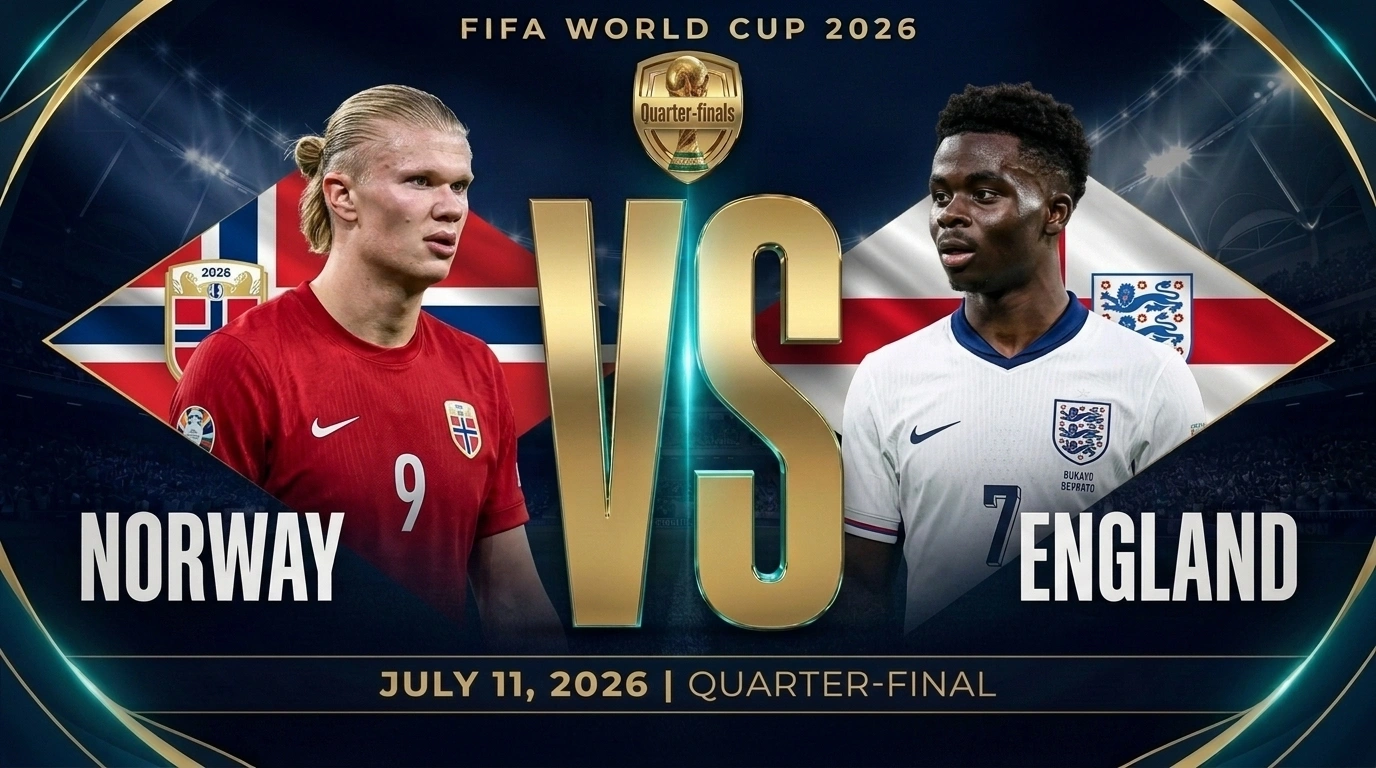
Norway vs England Quarter-final Details
Core match information is aligned with the FIFA Match Centre and official tournament listings. Venue naming follows FIFA's World Cup 2026 convention.
Why This Quarter-final Matters
Quarter-finals are where tournament paths stop being theoretical and become legacy-defining. Norway know this terrain in a way their nation has rarely experienced at this level: a Scandinavian side that has waited decades for a World Cup run of genuine consequence, now standing one win away from a semi-final in Atlanta. England know it from the opposite angle — a football nation that has carried expectation for generations and now believes, after beating Mexico 3–2 in the Round of 16, that this squad finally has the emotional resilience to match its individual quality.
This tie is also about what the expanded 2026 World Cup has become. The road has been longer: group stage, Round of 32, Round of 16, and now a quarter-final in South Florida that feeds directly into a semi-final in Atlanta on July 15 against the Argentina vs Switzerland winner. Both teams have had to manage minutes, adapt to travel across North America and learn how to control games in an environment where humidity, heat and knockout pressure can swing violently from one matchday to the next.
On the pitch, the contrast is compelling. Norway offer vertical directness built around Erling Haaland's movement, Martin Ødegaard's precision in the final third and a defensive structure that has proven it can absorb pressure from world-class attacks — as the 2–1 win over Brazil demonstrated. England bring layered possession, tactical flexibility and the ability to hurt opponents in almost any game state, with Harry Kane's link play, Jude Bellingham's box-to-box authority and Phil Foden's creativity forming the spine of a team that has grown into the tournament rather than peaked too early.
For anyone searching for a Norway vs England prediction, preview, betting tips or expected lineups, the key is understanding that this is not a simple "favourite vs outsider" dynamic. It is a clash between Norway's Haaland-led directness and England's tournament momentum — two hardened knockout identities, both of which have proven they can carry the pressure of elimination games at the very highest level in this World Cup cycle.
Miami Stadium adds another layer. The venue has hosted major international fixtures before and the July evening kickoff in Miami Gardens will test conditioning, hydration strategy and in-game management. Norway's compact defensive approach may actually benefit from a slower, more deliberate tempo in the first half, while England's superior squad rotation could matter enormously if the match extends beyond 90 minutes. The winner does not just reach a semi-final — they earn the right to face either Argentina or Switzerland in Atlanta, with a potential path to the final in New Jersey still alive.
How Norway and England Reached the Last Eight
Norway: from group grit to giant-killing
Group stage: Norway were drawn into a demanding group and navigated it with a clear identity. Norway have mixed periods of controlled possession with rapid vertical transitions throughout the tournament, using Haaland as the focal point without becoming a one-man team. Ødegaard's distribution and the emerging influence of young midfielder Sverre Nypan gave Norway enough variety to finish the group stage with genuine momentum.
Round of 32: The expanded knockout phase forced Norway to manage risk in a new kind of fixture. Against a technically capable opponent they leaned on defensive discipline — compressing the space between midfield and defence, forcing play wide and trusting Haaland to convert the few high-quality chances they manufactured on the break.
Round of 16 vs Brazil: The 2–1 victory was the result that changed how the world views this Norway team. Brazil dominated stretches of possession, but Norway's compact 4-4-2 block frustrated central progression and Haaland punished the spaces Brazil left when pushing for an equaliser. FIFA's event data showed Brazil with more of the ball for long spells, but Norway with the sharper decisive moments — a classic underdog knockout script executed with composure.
The overall Norwegian arc is one of growing belief. The group stage showed they belong at this level; the Round of 32 showed they can win tight games; the Brazil result showed they can beat a football superpower when the stakes are highest. That is exactly the version of Norway you expect to see in a quarter-final — direct, disciplined and dangerous in moments rather than in sustained waves.
England: building tournament momentum
Group stage: England began the tournament with controlled performances that prioritised structure over spectacle. They conceded very few high-quality chances across three games, while limiting opponents to lower-quality phases for long periods and prioritising patient build-up over chaotic attacking.
Round of 32: In the first knockout match England showed more attacking intent, using Bellingham's forward runs and Foden's movement between the lines to create overloads in the final third. The opponent saw less of the ball than in the group stage; England saw more of the game's best chances.
Round of 16 vs Mexico: The 3–2 scoreline in a high-intensity fixture was the performance that confirmed England's tournament momentum. Mexico pushed England hard and the game swung repeatedly, but Kane's hold-up play, Bellingham's energy and Foden's decisive contributions in the final third proved England can win when the margins are narrow and the atmosphere is hostile. The numbers backed up the eye test: a healthy xG total, multiple big chances and a team that looked increasingly comfortable in chaos.
If previous England cycles were defined by early promise and late disappointment, 2026 has been defined by gradual acceleration. They arrive in the quarter-final not as a team still finding its identity, but as a fully-formed knockout side that knows how it wants the match to look — and has the depth to adjust when the script changes.
Norway vs England: Tournament Stats Snapshot
This section uses official FIFA match reports and widely cited analytical models. Precise advanced metrics such as expected goals can vary slightly by provider, so treat the profiles as directional rather than exact to the second decimal place.
How Norway and England Match Up Tactically
Norway: Haaland-led directness, compact defensive block
Norway's build-up usually starts from a back four that prioritises verticality over prolonged circulation. Rather than passing through multiple phases to reach the final third, they look to move the ball forward quickly — either through Ødegaard's incisive passing from deep or direct channels into Haaland's runs. The striker's movement between centre-backs, his ability to hold the ball under pressure and his finishing from tight angles make him the gravitational centre of everything Norway do in attack.
Out of possession, Norway settle into a disciplined 4-4-2 mid-block. The two forwards — Haaland and a partner — screen central passes, the wide midfielders tuck in to form a narrow second line, and the full-backs stay disciplined, rarely jumping into challenges they cannot win. Everything is about buying the extra half-second needed for the midfield line to slide and close gaps. Against Brazil, this structure forced the Seleção into wide areas and limited their access to the central corridor.
The weakness, when it appears, tends to show up when Norway are pinned deep for extended periods. Even a very organised block starts to accumulate fatigue and small errors after 60+ minutes of sustained pressure. England will look to accumulate corners, cut-backs and second balls until one of those small cracks becomes a decisive chance. Norway's best response is to stay patient, avoid reckless pressing and trust that Haaland needs only one or two touches to change the scoreline.
Sverre Nypan has emerged as a fascinating tactical variable. The young midfielder offers progressive carrying and the confidence to receive in tight spaces, giving Norway an alternative route when Ødegaard is marked closely. His ability to draw fouls and play quick combinations with Haaland adds a layer of unpredictability that England's defence must account for.
England: layered possession, tournament-hardened flexibility
England's build-up usually starts from a back four that turns into a back three plus a single pivot in the first phase. One full-back pushes high to pin the winger, while the opposite full-back tucks inside to help outnumber Norway's first pressing line. When this works, England can move the ball into advanced midfield positions with relative safety, then create overloads around the box through Foden's movement and Bellingham's late runs.
Their pressing is now more game-state driven than all-out. In the first 15–20 minutes, expect an aggressive high press to test Norway's composure on the ball and disrupt their direct passing lanes. Once England take the lead, they tend to fall into a mid-block, with the forwards screening central passes and the midfield three compressing the centre. That dual identity — able to both hunt and contain — is one of the reasons their underlying defensive numbers are strong despite trying to score first in most games.
Kane's role as a link striker is critical. He drops between Norway's lines to receive, turns and releases Foden or Bellingham into space. Against a compact block, his hold-up play and ability to win fouls in dangerous areas can be as valuable as any goal. The Mexico game showed England at their best when the match became chaotic — Bellingham covering enormous ground, Foden finding pockets and Kane providing the reference point that kept attacks coherent.
The trade-off is rest defence. If both full-backs advance and Bellingham pushes high simultaneously, transition protection is thin. Norway's best chance of hurting England is to win the ball exactly in those moments and get the ball to Haaland before the structure can reset. One clean transition is all Norway need to stay competitive in this quarter-final.
Coaching philosophies and likely adjustments
England's coaching staff have repeatedly shown a willingness to adjust shapes within games, particularly by changing the roles of their wide forwards and midfielders. They can move from a narrow 4-3-3 to more of a 4-2-3-1 with Foden as a No. 10 between the lines if Norway's block is denying space in the half-spaces. They can also bring on fresh wide players after 60 minutes to exploit tiring Norwegian legs.
Norway's staff, meanwhile, have doubled down on an approach that prioritises stability and directness. Their in-game tweaks often involve changing which midfielder stays deeper to protect the back four and how aggressively Haaland's strike partner presses England's centre-backs. Against England, expect Norway to keep their block compact and only release Haaland on the counter when the ball is won in England's half or just inside Norway's own.
The Miami heat adds a tactical dimension both coaches must manage. England's superior squad depth gives them more options to rotate energy-intensive roles — particularly Bellingham's box-to-box workload — while Norway may need to accept longer periods without the ball to conserve energy for decisive transition moments. Substitutions could be more influential here than in a typical European knockout tie.
Key Individual Battles
Haaland vs England's centre-backs
The defining duel of the match. Haaland's movement between and behind England's centre-backs will test their positioning, communication and ability to defend without fouling in dangerous areas. If Norway can isolate Haaland often enough — particularly on direct balls over the top or quick transitions — England will be stretched. If England's centre-backs can deny service and limit Haaland to half-chances, Norway's attacking threat drops dramatically.
Ødegaard vs England's midfield press
Norway's captain is the player most likely to unlock England's structure with a single pass. His ability to receive under pressure, turn and find Haaland or Nypan in space will shape how dangerous Norway are in transition. England's midfield — led by Bellingham — must close down Ødegaard quickly and force Norway into longer, less accurate passes.
Bellingham vs Norway's defensive midfield
The battle for second balls and loose clearances in front of Norway's defence will shape how dangerous England's pressure becomes. If Bellingham wins those duels and drives forward, waves of attacks will keep crashing down on Norway's block. If Norway's holding midfielder cleans up and finds Ødegaard or Nypan, Norway can breathe and counter.
Foden vs Norway's full-backs
Foden's movement between the lines and his ability to receive in the half-spaces will test Norway's wide defenders. If he finds pockets consistently, England can create the kind of sustained pressure that eventually breaks compact blocks. Norway's full-backs must stay disciplined — jumping out of position to press Foden risks leaving the channel open for England's overlapping full-backs.
Set-piece specialists
England's delivery from wide areas and Kane's movement in the box face Norway's well-drilled defensive organisation. Quarter-finals are often decided by a single set play; whichever side manages the details — blocks, runs, second balls — more cleanly may decide the tie. Norway's aerial threat through Haaland makes them dangerous on the counter from England corners too.
Goalkeepers under different types of stress
England's goalkeeper will see fewer but very high-value shots on transitions from Haaland; Norway's keeper is likely to face more volume, crosses and sustained pressure. Both have histories of handling high-pressure tournaments well; one mistimed decision can still flip an entire World Cup quarter-final.
Key Players and Their Expected Impact
Norway
- Erling Haaland — The tournament's most feared direct striker. His shot maps show a consistent stream of attempts from central zones and inside the box. Even when he does not score, his movement bends defensive structures and creates space for Ødegaard and Nypan. Against Brazil he needed fewer than five touches to decide the tie.
- Martin Ødegaard — Norway's on-ball brain and the player most capable of unlocking England's block with incisive passing. His ability to receive under pressure, switch play and find Haaland in space makes him indispensable. Set-piece delivery from his right foot is another weapon in tight knockout games.
- Sverre Nypan — The young midfielder has grown into the tournament with progressive carrying and composure beyond his years. He offers Norway an alternative route when Ødegaard is marked, drawing fouls and linking play with Haaland in dangerous areas.
- Norway's centre-back pairing — Whichever pairing starts matters less than how they deal with Kane's hold-up play and England's movement between the lines. Aerial duels against Haaland's support runs will be equally critical.
More on the squad: Norway analysis
England
- Harry Kane — England's reference point in attack. His hold-up play, link-up combinations and ability to win fouls in dangerous areas keep attacks coherent even when Norway's block is functioning well. Against Mexico he showed he can score and create in high-chaos environments.
- Jude Bellingham — The engine of this England side. His box-to-box energy, late runs into the box and defensive work rate make him the player Norway must neutralise most urgently. Tournament tracking data shows him among the highest distance-covered players in the competition.
- Phil Foden — England's most creative outlet in the final third. His movement between the lines, close control in tight spaces and ability to combine with Kane and Bellingham give England the variety needed to break compact blocks over 90 minutes.
- England's full-back pairing — Their balance between attacking width and rest-defence discipline will be tested by Norway's transitions. One mistimed forward run could leave the channel open for Haaland at the worst possible moment.
More on the squad: England analysis
Expected Lineups (Provisional)
These lineups are projections based on tournament usage and tactical logic; official starting XIs will only be known from FIFA and federation channels on matchday.
Norway (4‑4‑2)
              GK

            RB   CB      CB   LB

            RM   CM      CM   LM

               Haaland   ST
- GK: Ørjan Nyland
- DEF: Marcus Pedersen, Leo Østigård, Kristoffer Ajer, David Møller Wolfe
- MID: Martin Ødegaard, Patrick Berg, Sander Berge, Antonio Nusa
- ATT: Erling Haaland, Jørgen Strand Larsen
England (4‑3‑3)
              GK

            RB   CB      CB   LB

                 DM   CM
                    AM

               RW  Kane   Foden
- GK: Jordan Pickford
- DEF: Kyle Walker, John Stones, Marc Guéhi, Luke Shaw
- MID: Declan Rice, Jude Bellingham, Phil Foden
- ATT: Bukayo Saka, Harry Kane, Anthony Gordon
Official Information on Injuries and Suspensions
At the time of writing, there are no new officially confirmed suspensions that automatically rule key starters out of this quarter-final. Long-term absences are already priced into the squads that arrived at the tournament and are reflected in the official FIFA and federation lists.
Short-term knocks and load-management decisions are harder to read. Training sessions are often partially closed and medical updates deliberately vague. Where media outlets mention "doubts" over particular players, those notes should be treated as provisional until an official matchday squad is published.
No major injury or suspension has been officially confirmed by FIFA or either federation as automatically ruling out a key starter at publication time. Norway's medical staff have publicly played down illness concerns around the squad, while England's short turnaround after the Mexico match makes recovery management important rather than a confirmed availability crisis.
Because of that, every predicted XI in this preview is explicitly editorial. For final confirmation, use the match centre on FIFA.com or the official communication channels of the Norwegian and English federations on game day.
What Could Decide Norway vs England
First goal: An early England goal forces Norway out of their comfort zone and opens channels for sustained pressure; an early Norwegian goal through Haaland turns the match into a siege where every England cross and shot feels heavier, and Norway can retreat into their proven defensive shape.
Game management: England must avoid oscillating between overly cautious and overly frantic. If they can push in controlled waves — 10–15 minute spells of intense pressure followed by calmer circulation — they can increase Norway's defensive workload without exposing themselves to constant Haaland transitions.
Bench depth: England have more like-for-like quality off the bench. Fresh wingers and attacking midfielders after 60 minutes can tilt a tiring Norwegian defence in the Miami heat. Norway's changes will likely focus on maintaining structure and adding specific weapons — pace, aerial power — rather than radically changing the game script.
Haaland's service: Norway's entire attacking threat flows through their No. 9. If Ødegaard and Nypan can find him consistently — even with limited touches — Norway stay dangerous. If England cut the supply lines and isolate Haaland from the ball, Norway's offensive output drops sharply.
Extra time and penalties: The longer this stays level, the more Norway's emotional resilience and giant-killing confidence count. England cannot assume that "talent will find a way" late on; they must actively protect themselves from the randomness of spot kicks and the fatigue that favours the more direct team.
Set pieces: Both teams are dangerous here, but England spend more time in the attacking third and therefore generate more opportunities. One blocked shot leading to a corner can be the moment that breaks a contest like this. Norway's aerial threat on the counter from England set pieces is an underrated danger.
Heat and humidity: Miami Gardens in July is a genuine physical test. England's superior rotation options and deeper squad give them an edge if the match extends beyond 90 minutes. Norway's compact defensive approach may help conserve energy, but only if they avoid being pinned in their own half for entire halves.
Expected Match Scenario
Over most simulated match states, England settle into 55–60% possession with Norway defending in a compact 4-4-2 block. England's front three and midfield repeatedly test the central corridor and half-spaces, while Norway rely on quick vertical passes from Ødegaard and Nypan to launch Haaland into the space behind England's advancing full-backs.
The AI tactical model rates the probability of extra time as moderate — higher than the average group-stage match but lower than some quarter-finals — because England's tournament momentum and superior chance creation give them a path to a regulation-time win. In paths where England convert an early chance, the win tendency shifts toward a controlled 2–0 or 2–1. In paths where Norway hold out until at least the 70th minute and find Haaland on one clean transition, the game becomes increasingly even and penalty-shootout likelihood rises.
Expected goals projections consistently show England with the higher xG total, but not by a runaway margin. Norway's xG profile is thinner but spikier, reflecting fewer total shots but a decent share of those coming from fast transitions where Haaland faces undermanned defences. That asymmetry underlines the balance of risk: England are favoured, but they will have to walk a tightrope between applying pressure and not giving Norway the one counter they need.
The model also weights England's Mexico performance heavily — a 3–2 win in a chaotic, high-stakes environment suggests this squad has developed the emotional resilience that previous England cycles lacked. Norway's Brazil result carries equal narrative weight: proof that this team can beat elite opposition when the tactical plan is executed with discipline. The collision of these two momentum stories is what makes this quarter-final genuinely difficult to call with high confidence.
Norway vs England Betting Analysis
Editorial analysis only — no guarantees, no financial advice. Always check live markets and limits, and never bet more than you can afford to lose.
England to qualify aligns with their underlying edge and tournament momentum while acknowledging Norway's proven ability to beat elite sides and drag the tie into extra time.
England or Draw is a way to express confidence in England's floor without relying on a 90-minute win inside regulation time against a team that beat Brazil.
Norway +1 or +1.25 can be appealing if markets heavily price in a comfortable England win, given how difficult it is to break Norway's structure by a wide margin and Haaland's ability to keep the score close.
Over 2.5 goals reflects the open nature of both teams' recent knockout games — Norway 2–1 Brazil, England 3–2 Mexico — though quarter-final caution could pull the total lower.
BTTS (Yes) leans on Haaland's scoring record and England's attacking quality; BTTS (No) becomes interesting if markets overprice Norway's chances of finding the net against a settled England defence.
Haaland shots, Kane goalscorer, Bellingham tackles/interceptions, or Foden final-third passes are markets that logically follow their tactical roles — not gut feel.
The core idea: markets usually price England's class gap correctly but can underestimate how effectively Norway compress games and how dangerous Haaland is in even a single transition. Strategies that back England to qualify while treating large handicaps with caution better match the real risk profile of this quarter-final.
AI Exact Score & Confidence
Primary exact-score forecast: England 2–1 Norway
Editorial confidence in England qualifying: ~58% (editorial estimate, not market odds).
This score reflects a script where England create more chances and likely score first through sustained pressure, but Norway find one reply through a Haaland transition or a set piece. England's second goal arrives either from a period of intense pressure after Norway equalise, or from a moment when Norway are forced to open up chasing the game in the final 15 minutes.
Alternative scenario: 1–0 England in a very tight game where Norway's block holds until late, or 1–1 after 90 minutes decided in extra time or penalties. A comfortable England blowout looks less likely given Norway's defensive quality, their Brazil result and Haaland's ability to punish any defensive lapse.
The 58% confidence figure reflects genuine respect for Norway's knockout credentials. This is not a tie where England can expect to control every phase — Norway have earned the right to be taken seriously at this stage of the tournament, and the gap between the teams is narrower than England's squad depth alone might suggest.
Expert Verdict on Norway vs England
England remain the side with more paths to victory: squad depth, structural flexibility, threat in sustained possession and the tournament momentum that comes from surviving a 3–2 thriller against Mexico. But those are exactly the teams that face the narrowest margin for error against a Norway side that has already proved it can beat Brazil with discipline and directness.
Norway arrive in Miami Gardens with Haaland as the most in-form striker in the knockout phase, Ødegaard as one of the tournament's most reliable creators and a defensive structure that has frustrated world-class attacks. If England misorganise rest-defence even once — if Bellingham pushes too high and a full-back is caught forward — Haaland may be enough to flip the script on his own.
Overall this looks like a quarter-final where England are logical favourites, but the win will be more about discipline and patience than fireworks. England must respect Norway's Brazil result, manage the Miami conditions intelligently and avoid the impatience that has cost previous generations. If they do that, their quality — Kane, Bellingham, Foden and the depth behind them — should prevail 2–1. If not, Norway have already written one giant-killing story in this tournament and have the tools to write another.
Norway vs England Quarter-final FAQ
When and where is Norway vs England played?
FIFA's official schedule lists the Norway vs England quarter-final on July 11, 2026 at Miami Stadium in Miami Gardens, Florida, kickoff at 5:00 PM Eastern Time (ET).
What stage of the World Cup is this?
Norway vs England is a quarter-final (Round of 8) at World Cup 2026, Match 99. The winner advances to the semi-finals.
Who plays the Norway vs England winner in the semi-final?
The winner of this tie meets the Argentina vs Switzerland winner in the semi-final in Atlanta on July 15, per FIFA's official bracket.
Who is the favourite in our model?
England hold an edge in depth, xG and attacking variety after their 3–2 win over Mexico, so our model and editorial analysis moderately favour them to qualify at roughly 58% confidence. Norway's 2–1 victory over Brazil shows the gap is not huge.
What is the predicted score?
Our primary exact-score forecast is England 2–1 Norway, reflecting a match where England create more chances but Norway find a reply through Haaland-led directness.
How likely is extra time?
Extra-time chances are moderate to above average for a quarter-final because both teams are comfortable in low-scoring games and Norway's compact block can keep margins narrow even under sustained pressure.
How reliable are the predicted lineups?
They are based on previous matches and tactical patterns but are not official. Confirmed starting XIs are published by FIFA and federations 60–90 minutes before kickoff.
Where can I read deeper team analysis?
See our Norway and England team pages, plus the full Teams hub.
More World Cup 2026 Quarter-final Resources
Continue on the predictions hub, or read our other quarter-final previews: France vs Morocco, Spain vs Belgium, and Argentina vs Switzerland.