

Narrow Margins. Giant Stakes.
 France
 Morocco
France vs Morocco Prediction
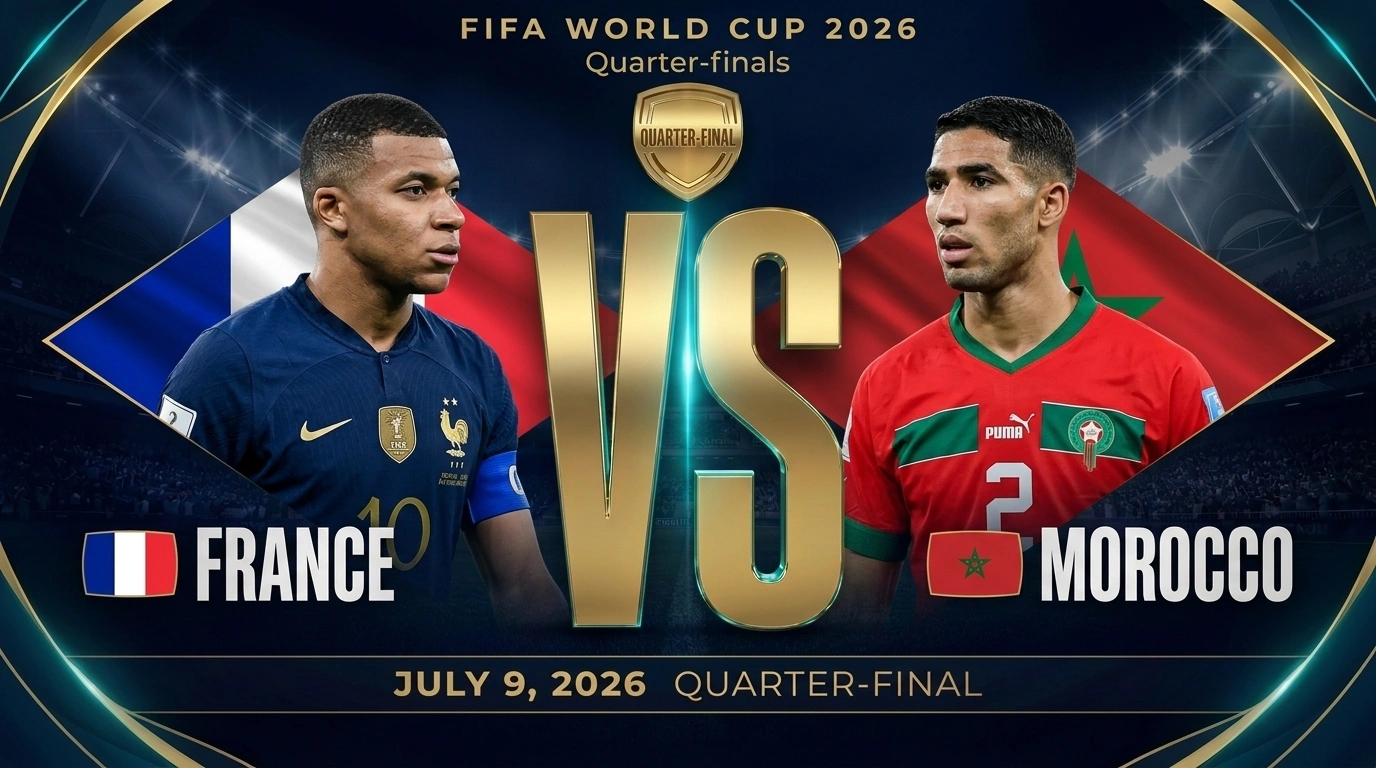
France vs Morocco at Boston Stadium is a quarter-final that blends heavyweight expectation with underdog belief. France arrive as perennial contenders; Morocco arrive as a team that has already redrawn Africa’s World Cup ceiling once and now want to prove that run was only the beginning.
Why This Quarter-final Matters
Quarter-finals are where tournament paths stop being theoretical and become legacy-defining. France know this terrain better than almost anyone: world champions in 2018, finalists in 2022, again in the last eight with a squad deep enough to win the whole thing. Morocco arrive with a different weight — the responsibility of carrying a region that watched their 2022 semi-final run with pride and now expects something more than a romantic underdog story.
This tie is also about what the expanded 2026 World Cup has become. The road has been longer: group stage, Round of 32, Round of 16, and now a quarter-final in Boston that feeds directly into a semi-final in Dallas. Both teams have had to manage minutes, adapt to travel and learn how to control games in an environment where momentum can swing violently from one matchday to the next.
On the pitch, the contrast is compelling. France offer layers of attacking quality, tactical flexibility and the ability to hurt opponents in almost any game state. Morocco bring a structure that has frustrated some of the best attacks in the world across two cycles, allied with full-backs and wide players who turn defence into threat in seconds. On paper, France vs Morocco is a meeting of the team that wants the match to stretch and the team that wants it to compress.
For anyone searching for a France vs Morocco prediction, preview, betting tips or expected lineups, the key is understanding that this is not a simple “favourite vs outsider” dynamic. It is a clash between two hardened knockout identities, both of which have proven they can carry the pressure of elimination games at the very highest level.
How France and Morocco Reached the Last Eight
France: from group control to knockout pragmatism
Group stage: France came through Group I with the authority expected from a tournament favourite, navigating matches against Senegal, Iraq and Norway with strong territorial control and enough attacking variety to avoid becoming dependent on one pattern. The group stage established their rhythm: high possession, wide rotations, quick entries into the box and enough depth to keep key forwards fresh.
Round of 32 vs Sweden: France delivered one of their cleanest knockout performances with a 3–0 win over Sweden. The result showed their ability to combine control with end product: they protected central areas, kept the game away from unnecessary chaos and used their attacking depth to turn pressure into a comfortable margin.
Round of 16 vs Paraguay: A 1–0 win that looked narrow on the scoreboard but much more comfortable in terms of shot quality and territorial control. France’s expected goals edge was clear in most public models, even if their own inefficiency and a few late set pieces for Paraguay kept the anxiety level high.
The overall French arc is one of gradual tightening. The group stage showed flair and depth; the Round of 32 and Round of 16 showed that the coaching staff are prepared to trade some attacking chaos for greater stability. That is exactly the version of France you expect to see in a quarter-final — one that is happy to win 1–0 if the game script demands it.
Morocco: sharpening a proven identity
Group stage: Morocco again built their campaign on defensive solidity. They conceded very few high-quality chances across three games, with FIFA’s event data showing a low xG against and a shot map dominated by low-probability efforts from the edge of the box.
Round of 32 vs Netherlands: Morocco eliminated the Netherlands after a 1–1 draw and a penalty shootout, confirming that their knockout identity is not built only on defending. They absorbed pressure, stayed emotionally stable and found a way through one of Europe’s most technically gifted sides.
Round of 16 vs Canada: The 3–0 scoreline in Houston was the performance that changed global expectations. Morocco were ruthless, turning Canadian ambition into precisely the kind of open spaces their wingers and full-backs crave. The numbers backed up the eye test: a healthy xG total, multiple big chances and another low xG against.
If 2022 was proof that Morocco could hang with the best, 2026 has been proof that they can shape matches against them. They arrive in the quarter-final not as a Cinderella story, but as a fully-formed knockout team that knows exactly how it wants the match to look.
France vs Morocco: Tournament Stats Snapshot
This section uses official FIFA match reports and widely cited analytical models. Precise advanced metrics such as expected goals can vary slightly by provider, so treat the profiles as directional rather than exact to the second decimal place.
How France and Morocco Match Up Tactically
France: layered possession, selective pressing
France’s build-up usually starts from a back four that turns into a back three plus a single pivot in the first phase. One full-back tucks inside, helping them outnumber the first Moroccan line, while the opposite full-back stays wide to pin the winger and open space for interior combinations. When this works, France can move the ball into advanced midfield positions with relative safety, then create three-versus-two situations around the box.
Their pressing is now more game-state driven than all-out. In the first 15–20 minutes, expect an aggressive high press to test Morocco’s composure on the ball. Once France take the lead, they tend to fall into a mid-block, with the forwards screening central passes and the midfield three compressing the centre. That dual identity — able to both hunt and contain — is one of the reasons their underlying defensive numbers are strong despite trying to score first in most games.
The weakness, when it appears, tends to show up in rest defence. If both full-backs advance and a midfielder vacates the holding space at the same time, transition protection is thin. Morocco’s best chance of hurting France is to win the ball exactly in those moments and attack the spaces either side of the French pivot before the structure can reset.
Morocco: compact block, vertical threat
Morocco’s 4–1–4–1 / 4–3–3 out of possession is designed to suffocate central progression. The striker shades passes toward one side, the wingers drop to form a narrow second line, and the full-backs stay disciplined, rarely jumping into challenges they cannot win. Everything is about buying the extra half-second needed for the midfield line to slide and close gaps.
On the ball, Morocco are far from primitive. They use short combinations to draw pressure, then look for switches into the wide zones where Hakimi and the winger on his side can attack. Ziyech’s long diagonal passes are still a key weapon: they allow Morocco to change the point of attack without needing to pass through central congestion against France’s midfield.
The trade-off is that Morocco accept longer stretches without the ball. That can become a problem if they spend 60+ minutes pinned deep, because even a very organised block starts to accumulate fatigue and small errors. France will look to accumulate corners, free kicks and cut-backs until one of those small cracks becomes a decisive chance.
Coaching philosophies and likely adjustments
Didier Deschamps’ staff have repeatedly shown a willingness to adjust shapes within games, particularly by changing the roles of their wide forwards. They can move from a narrow 4–3–3 to more of a 4–2–3–1 with a No. 10 between the lines if Morocco’s block is denying space in the half-spaces. They can also bring on a more direct striker if the match requires constant penalty-box occupation.
Walid Regragui, meanwhile, has doubled down on an approach that prioritises stability. His in-game tweaks often involve changing which winger stays higher on transition and how aggressively Hakimi is allowed to overlap. Against France, expect him to keep Hakimi’s starting position slightly deeper than usual to manage the Mbappé threat, then release him selectively when Morocco have clear control of the ball.
Key Individual Battles
Mbappé vs Hakimi
One of the defining duels of the match. Mbappé’s inside-left channel runs face his club team‑mate and one of the few full-backs with the speed to stay with him. If France can isolate Mbappé often enough, Morocco will be stretched; if Hakimi can delay and channel him into crowded zones, Morocco’s block remains intact.
French pivot vs Amrabat
The battle for second balls and loose clearances in front of Morocco’s defence will shape how dangerous France’s pressure becomes. If the French pivot wins those duels, waves of attacks will keep crashing down; if Amrabat cleans up and finds safe outlets, Morocco can breathe and counter.
Set-piece specialists
Griezmann’s delivery and the aerial power of France’s centre-backs face Morocco’s well-drilled zonal scheme. Quarter-finals are often decided by a single set play; whichever side manages the details — blocks, runs, second balls — more cleanly may decide the tie.
Goalkeepers under different types of stress
The French goalkeeper will see fewer but very high-value shots on transitions; Bono is likely to face more volume, crosses and long-range efforts. Both have histories of handling high-pressure tournaments well; one mistimed decision can still flip an entire World Cup.
Key Players and Their Expected Impact
France
- Kylian Mbappé — Tournament shot maps show a consistent stream of attempts from the left half-space and inside channel. Even when he does not score, he bends defensive structures in ways that open pockets for others.
- Antoine Griezmann — Continues to operate as France’s on‑ball brain, linking phases and setting the tempo. His set-piece delivery is another non‑negotiable weapon in tight knockout games.
- Aurélien Tchouaméni — Shields transitions and is responsible for stopping Morocco’s first counter-pass. If he reads the game well, Morocco’s main threat becomes significantly less dangerous.
- Dayot Upamecano / Ibrahima Konaté — Which pairing Deschamps chooses matters less than how they deal with Morocco’s direct balls and second‑phase attacks.
More on the squad: France analysis
Morocco
- Achraf Hakimi — Has to balance containing Mbappé with providing width in transition. Few players will influence both phases as directly as he will here.
- Sofyan Amrabat — The shield in front of the back four. His positioning and ball‑winning help Morocco compress the middle and launch counters from stable platforms.
- Hakim Ziyech — Even with limited touches, his left foot can change matches — whether through switches of play, cut‑backs or direct shots from distance.
- Yassine Bounou — Proven under the highest pressure in major tournaments and central to Morocco’s calm defensive identity. If this quarter-final drifts toward extra time or penalties, his presence in goal becomes an edge for Morocco.
More on the squad: Morocco analysis
Expected Lineups (Provisional)
These lineups are projections based on tournament usage and tactical logic; official starting XIs will only be known from FIFA and federation channels on matchday.
France (4‑3‑3)
              GK

            RB   CB      CB   LB

                 DM   CM
                    AM

               RW   CF   Mbappé
- GK: Mike Maignan
- DEF: Koundé, Upamecano, Konaté, Hernández
- MID: Rabiot, Camavinga, Griezmann
- ATT: Dembélé, Mbappé, Barcola
Morocco (4‑1‑4‑1)
                     CF

            LW     AM    Ziyech
                   CM   CM

            LB    CB    CB   Hakimi

                     GK
- GK: Bounou
- DEF: Mazraoui, Saïss, Aguerd, Hakimi
- MID: Amrabat; Ounahi, Amallah; Boufal, Ziyech
- ATT: En‑Nesyri
Official Information on Injuries and Suspensions
At the time of writing, there are no new officially confirmed suspensions that automatically rule out a large group of starters, but there are important matchday concerns. Reuters reported that Aurélien Tchouaméni is an injury doubt for France, while Morocco’s Ismael Saibari is also expected to be unavailable. Those issues are reflected in the projected lineups and in the tactical balance of the preview.
Short‑term knocks and load‑management decisions remain difficult to read. Training sessions are often partially closed and medical updates deliberately vague. Where media outlets mention “doubts” over particular players, those notes should still be treated as provisional until an official matchday squad is published.
Because of that, every predicted XI in this preview is explicitly editorial. For final confirmation, use the match centre on FIFA.com or the official communication channels of the French and Moroccan federations on game day.
What Could Decide France vs Morocco
First goal: An early French goal forces Morocco out of their comfort zone and opens channels for transitions; an early Moroccan goal turns the match into a siege where every French cross and shot feels heavier.
Game management: France must avoid oscillating between overly cautious and overly frantic. If they can push in controlled waves — 10–15 minute spells of intense pressure followed by calmer circulation — they can increase Morocco’s defensive workload without exposing themselves to constant counters.
Bench depth: France have more like‑for‑like quality off the bench. Fresh wingers and attacking midfielders after 60 minutes can tilt a tiring defence. Morocco’s changes will likely focus on maintaining structure and adding specific weapons (pace, aerial power) rather than radically changing the game script.
Extra time and penalties: The longer this stays level, the more Morocco’s emotional resilience and recent penalty‑shootout win over the Netherlands count. France cannot assume that “talent will find a way” late on; they must actively protect themselves from the randomness of spot kicks.
Set pieces: Both teams are dangerous here, but France spend more time in the attacking third and therefore generate more opportunities. One blocked shot leading to a corner can be the moment that breaks a contest like this.
Fatigue and travel: Both squads have logged serious travel in a North American World Cup. How coaching staffs manage rotations in the hour before potential extra time — not just during — will have a real impact on which team finishes stronger.
Expected Match Scenario
Over most simulated match states, France settle into 55–60% possession with Morocco defending in a compact 4‑1‑4‑1 block. France’s front three repeatedly test the right‑hand channel, while Morocco rely on quick vertical passes to launch attacks into the space behind France’s advancing full‑backs.
The AI tactical model rates the probability of extra time as moderate — higher than the average quarter-final — because both sides are comfortable in low‑margin contests and have goalkeepers capable of extending matches with key saves. In paths where France convert an early chance, the win tendency shifts toward a controlled 1–0 or 2–0. In paths where Morocco hold out until at least the 70th minute, the game becomes increasingly even and penalty‑shootout likelihood rises.
Expected goals projections consistently show France with the higher xG total, but not by a runaway margin. Morocco’s xG profile is thinner but spikier, reflecting fewer total shots but a decent share of those coming from fast, undermanned defensive transitions for France. That asymmetry underlines the balance of risk: France are favoured, but they will have to walk a tightrope between applying pressure and not giving Morocco the one transition they need.
France vs Morocco Betting Analysis
Editorial analysis only — no guarantees, no financial advice. Always check live markets and limits, and never bet more than you can afford to lose.
France to qualify aligns with their underlying edge while acknowledging Morocco’s potential to drag the tie into extra time or penalties.
France or Draw is a way to express confidence in France’s floor without relying on a 90-minute win inside regulation time.
Morocco +1 or +1.25 can be appealing if markets heavily price in a comfortable French win, given how difficult it is to break Morocco’s structure by a wide margin.
Under 2.5 goals reflects the typical quarter-final profile and Morocco’s defensive strength, but without live odds this is only a tactical skeleton—not a recommendation.
BTTS (No) leans on Morocco’s historically tight knockout games; BTTS (Yes) becomes interesting if lines are heavily skewed toward a low-scoring script.
Mbappé shots, Ziyech final-third passes, or Hakimi tackles/interceptions are markets that logically follow their tactical roles—not gut feel.
The core idea: markets usually price the class gap correctly but can underestimate how effectively Morocco compresses games. Strategies that back France to qualify while treating large handicaps with caution better match the real risk profile of this quarter-final.
AI Exact Score & Confidence
Primary exact-score forecast: France 2–1 Morocco
Editorial confidence in France qualifying: ~68% (editorial estimate, not market odds).
This score reflects a script where France create more chances and likely score first, but Morocco find one reply through transitions or a set piece. France’s second goal arrives either from sustained pressure or a moment when Morocco are forced to open up.
Alternative scenario: 1–0 France in a very tight game, or 0–0/1–1 after 90 minutes decided in extra time or penalties. A blowout looks less likely given Morocco’s defensive quality and discipline.
Expert Verdict on France vs Morocco
France remain the side with more paths to victory: squad depth, structural flexibility, threat in transition, and set-piece quality. But those are exactly the teams that face the narrowest margin for error against Morocco.
Morocco return to a quarter-final with the same toolkit that shocked the world four years ago: a compact block, composure, and the ability to punish any gap between the lines. If France misorganize rest-defence even once, that may be enough to flip the script.
Overall this looks like a quarter-final where France are logical favourites, but the win will be more about discipline and patience than fireworks. If the champions manage emotions and avoid forcing the issue, their quality should show. If not, Morocco have already proved they can write bigger stories than this.
France vs Morocco Quarter-final FAQ
When and where is France vs Morocco played?
FIFA’s official schedule lists the France vs Morocco quarter-final on July 9, 2026 at Boston Stadium in Boston, kickoff at 4:00 PM Eastern Time (ET).
What stage of the World Cup is this?
France vs Morocco is a quarter-final (Round of 8) at World Cup 2026. The winner advances to the semi-finals.
Who plays the France vs Morocco winner in the semi-final?
The winner of this tie meets the Spain vs Belgium winner in the first semi-final in Dallas, per FIFA’s official bracket.
Who is the favourite in our model?
France hold an edge in depth, xG, and attacking variety, so our model and editorial analysis moderately favour them to qualify, but note the gap is not huge because of Morocco’s defensive strength.
How likely is extra time?
Extra-time chances are above average for a quarter-final because both teams are comfortable in low-scoring games and take defensive discipline seriously.
How reliable are the predicted lineups?
They are based on previous matches and tactical patterns but are not official. Confirmed starting XIs are published by FIFA and federations 60–90 minutes before kickoff.
Where can I read deeper team analysis?
See our France and Morocco team pages, plus the full Teams hub.
Where are the other quarter-final previews?
On the World Cup 2026 predictions hub you’ll find Spain vs Belgium, Norway vs England, and Argentina vs Switzerland previews, plus all earlier-stage coverage.
More World Cup 2026 Quarter-final Resources
Continue on the predictions hub, or read our other quarter-final previews: Spain vs Belgium, Norway vs England, and Argentina vs Switzerland.