

Narrow Margins. Giant Stakes.
 Argentina
 Switzerland
Argentina vs Switzerland Prediction
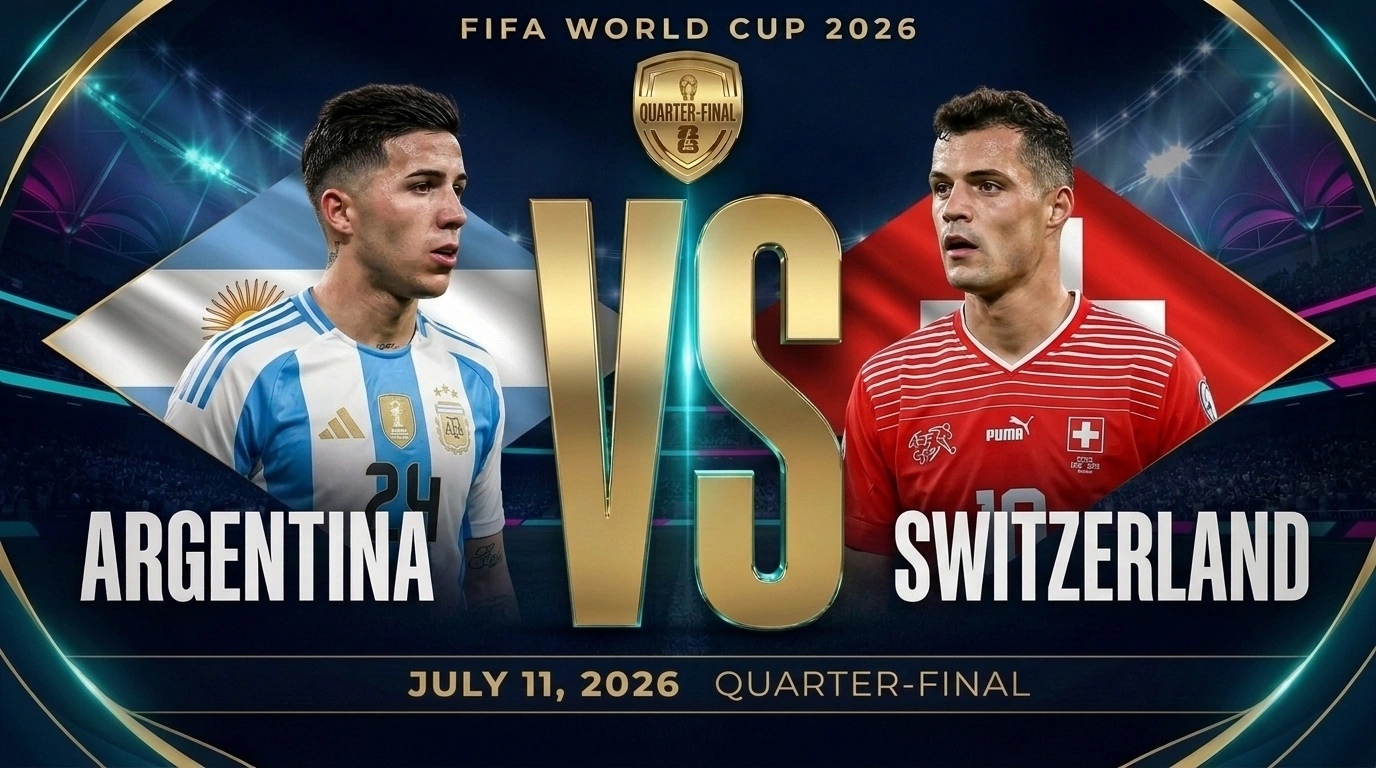
Argentina vs Switzerland in Kansas City pits the defending champions against a side that has made penalty-shootout resilience a tournament trademark. Argentina arrive with Lionel Messi still orchestrating knockout football at the highest level; Switzerland arrive with the belief that 120 minutes is only the beginning of the contest.
Why This Quarter-final Matters
Quarter-finals are where tournament narratives either harden into legend or collapse under the weight of expectation. Argentina carry the heaviest possible label — defending champions — and have spent the entire 2026 World Cup proving that the trophy on their crest is not merely symbolic. Switzerland carry a different kind of weight: the quiet confidence of a team that has navigated every elimination round without panic, including a dramatic penalty-shootout victory over Colombia that announced their arrival as genuine quarter-final contenders rather than polite European participants.
This tie is also a study in what the expanded 2026 format demands from elite squads. Both teams have already played group-stage football, a Round of 32 tie, and a Round of 16 fixture. Argentina survived a chaotic 3-2 comeback win over Egypt in Atlanta after trailing 2-0 late in the match; Switzerland survived 120 minutes and spot kicks against one of South America's most creative attacks in Vancouver. The road to Kansas City has been long, and the semi-final in Atlanta on July 15 — where the winner will face the Norway or England victor — now feels close enough to touch.
On the pitch, the contrast is fascinating. Argentina offer individual brilliance layered over collective understanding, with Messi still capable of bending a match in a single sequence and Lautaro Martínez providing the movement that unlocks compact blocks. Switzerland offer something Argentina have not faced often in this tournament: a team that genuinely does not fear going deep, that will accept long stretches without the ball if it means arriving at the 75th minute with defensive integrity intact and a route to penalties if necessary.
For anyone searching for an Argentina vs Switzerland prediction, preview, betting tips or expected lineups, the essential insight is that this is not a straightforward "champions vs underdog" narrative. It is a collision between Argentina's trophy-winning pedigree and Switzerland's penalty-shootout resilience — two knockout identities that have both been tested and proven across four matches in North America. The team that manages emotion, tempo and the fine margins of a July night in Kansas City will advance to a semi-final that could define the remainder of the tournament.
Kansas City Stadium — Arrowhead to American football fans — will provide an atmosphere unlike anything either squad has experienced so far. The evening kickoff at 9:00 PM ET means cooler temperatures and a crowd that has followed Argentina's journey with particular intensity across the United States. Switzerland, accustomed to being underestimated, may find that anonymity suits them. But underestimating Argentina in a quarter-final has ended more than one World Cup dream, and the Albiceleste know exactly how to weaponise the occasion.
How Argentina and Switzerland Reached the Last Eight
Argentina: champions navigating knockout turbulence
Group stage: Argentina topped their group with the authority expected of defending champions. official match data shows them controlling possession in all three fixtures, rotating intelligently without losing tactical identity, and finishing with a healthy goal difference that reflected their attacking depth beyond Messi alone.
Round of 32 vs Cape Verde: A 3-2 victory that looked comfortable in spells but exposed defensive vulnerability when Cape Verde pushed late. Argentina's expected goals edge was substantial, yet their finishing efficiency and a couple of set-piece concessions kept the anxiety level higher than the scoreline suggested.
Round of 16 vs Egypt: Another 3-2 win in Atlanta that followed a similar script — Argentina dominated territory and chance creation, Egypt punished moments of defensive disorganisation, and the Albiceleste needed late-game management to see it through. The result advanced them, but the pattern raised questions about whether the back line can hold firm against organised European structure.
Argentina's tournament arc is one of attacking quality meeting defensive fragility. They have scored freely and created consistently, but both knockout wins required them to survive periods of genuine pressure. That is precisely the version of Argentina Switzerland will look to exploit: a team brilliant enough to win any tie, but not yet ruthless enough to put opponents away early. Lionel Scaloni's staff have shown they can tighten the structure when needed, and the quarter-final is where that adjustment must arrive.
Switzerland: penalty-shootout resilience meets European discipline
Group stage: Switzerland navigated their group with characteristic pragmatism. They were not the most flamboyant side in the pool, but official match data shows a team that conceded few high-quality chances, managed game states intelligently, and accumulated enough points to advance without ever looking out of control.
Round of 32 vs Algeria: A controlled 2-0 win that showcased Switzerland at their best — compact without the ball, clinical when transitions opened, and defensively secure throughout. The clean sheet was not accidental; it reflected a defensive organisation that has been the foundation of their entire campaign.
Round of 16 vs Colombia: The match that changed Switzerland's tournament profile. After 120 minutes locked at a scoreline that demanded penalties, Switzerland won 4-3 from the spot. Gregor Kobel's saves, the composure of the takers, and Murat Yakin's calm sideline management all pointed to a team that had rehearsed this scenario and executed it under maximum pressure against one of the most talented attacks in the tournament.
Switzerland arrive in Kansas City not as a team hoping to survive, but as one that has already proven it can win when the margins are thinnest. The Colombia shootout victory is more than a result — it is psychological capital. Every Swiss player now knows that if this quarter-final drifts to spot kicks, they have the experience and nerve to compete. Argentina must win this match in regulation or extra time, because giving Switzerland a route to penalties is handing them their preferred game state.
Argentina vs Switzerland: Tournament Stats Snapshot
This section uses official FIFA match reports and widely cited analytical models. Precise advanced metrics such as expected goals can vary slightly by provider, so treat the profiles as directional rather than exact to the second decimal place.
How Argentina and Switzerland Match Up Tactically
Argentina: Messi-centric build-up, flexible pressing
Argentina's build-up typically flows through a back four that can morph into a back three when one full-back inverts alongside Enzo Fernández. The Chelsea midfielder has become the connective tissue of this team — receiving under pressure, turning play quickly, and finding Messi in pockets between the lines where few defenders can follow without creating space elsewhere. When this phase works, Argentina move the ball into advanced positions with relative safety, then rely on Messi's vision and Lautaro's movement to create overloads around the penalty area.
Their pressing intensity varies by game state. In the opening 20 minutes against Egypt, Argentina pressed aggressively and forced errors in dangerous areas. Once they established a lead, they dropped into a mid-block that conceded too much space on the flanks — a pattern Switzerland will study carefully. Scaloni's challenge in Kansas City is to find the balance between hunting the first goal and maintaining defensive compactness when Switzerland launch counters through Breel Embolo and Granit Xhaka's forward passing.
The structural weakness that has appeared in both knockout wins is rest-defence on transitions. When both full-backs push high and the midfield steps up simultaneously, the space behind Argentina's centre-backs becomes exploitable. Egypt found joy there; Cape Verde threatened from similar channels. Switzerland's best route to hurting Argentina is to win the ball in those transitional moments and attack the space before Enzo or the covering midfielder can recover. Embolo's physicality and direct running are tailor-made for that role.
Switzerland: compact block, shootout mentality
Switzerland's 4-2-3-1 / 4-4-2 out of possession is designed to deny central progression and funnel play wide into zones where Manuel Akanji and the defensive midfield pairing can manage risk. The back line stays disciplined, rarely stepping into challenges they cannot win, and the distance between midfield lines rarely exceeds 12 metres. Everything is calibrated to survive 90 minutes — and if necessary, 120 — with defensive integrity intact.
On the ball, Switzerland are more progressive than their possession numbers suggest. Xhaka's long diagonal passes and Ruben Vargas's dribbling on the left provide vertical threat without requiring sustained passing through Argentina's press. They use short combinations to draw pressure, then look for switches into wide areas where the full-backs can overlap. Against Colombia, this approach produced enough moments to keep the tie level through extra time and into penalties.
The trade-off is familiar: Switzerland accept long stretches without the ball and trust their organisation to hold. That strategy works until it does not — one lapse, one set piece, one moment of Messi magic can break a block that has held for 70 minutes. Yakin's in-game management against Colombia showed he understands when to add attacking personnel and when to lock the door. Against Argentina, expect him to keep the structure conservative in the first half and introduce pace and directness only if Switzerland need to chase the game after the interval.
Coaching philosophies and likely adjustments
Scaloni has repeatedly demonstrated a willingness to adjust within games, particularly by changing the roles of his wide forwards and the intensity of his press. Against Switzerland's compact block, he may push Messi into a slightly deeper role to draw Akanji out of position, creating space for Lautaro to attack the channel behind. He could also introduce a more direct striker from the bench if Argentina need penalty-box occupation in the final 30 minutes.
Yakin, meanwhile, has built his tournament approach around emotional control and structural reliability. His Colombia adjustments — introducing fresh legs in wide areas, managing Kobel's distribution under pressure, and keeping penalty takers calm — provide a blueprint for Kansas City. Against Argentina, expect him to keep Xhaka and the double pivot disciplined, limit Messi's free-kick opportunities in dangerous areas, and prepare his squad mentally for the possibility that this tie is decided from 12 yards again.
Key Individual Battles
Messi vs Akanji
The defining duel of the match. Akanji has grown into one of Europe's most reliable centre-backs and will likely be tasked with tracking Messi's movement between the lines. If Argentina can isolate Messi in the right half-space often enough, Switzerland's compact block will be stretched and gaps will appear for Lautaro and Ángel Di María. If Akanji can keep Messi in front of him and deny service into the box, Switzerland's defensive foundation remains intact for the long haul.
Enzo Fernández vs Granit Xhaka
The midfield control battle will shape how much Switzerland can build through the centre. Enzo's ability to receive under pressure and play forward quickly gives Argentina an edge in transition; Xhaka's experience and passing range allow Switzerland to bypass the press when they win possession. Whoever wins the second-ball duels in central midfield will influence whether Argentina dominate territory or Switzerland manage comfortable spells of circulation.
Lautaro Martínez vs the Swiss back line
Lautaro's movement in the channels is Argentina's most reliable weapon against deep blocks. His ability to peel off the shoulder of the last defender and arrive on Messi's through balls creates the kind of one-on-one chances that break organised defences. Switzerland's centre-backs must communicate constantly and track his runs even when the ball is on the opposite flank — one moment of lost concentration could be decisive.
Kobel vs Argentina's finishing
Gregor Kobel was the hero against Colombia, making the saves that kept Switzerland alive into penalties. Argentina will generate more volume than Colombia did, and Kobel will face a different type of stress — repeated shots from inside the box rather than occasional high-value transitions. Argentina's finishing has been inconsistent in this tournament; if they are clinical, Kobel cannot save everything. If they are wasteful, the Swiss goalkeeper becomes the foundation of another giant-killing narrative.
Key Players and Their Expected Impact
Argentina
- Lionel Messi — Still the tournament's most influential playmaker in the final third. His free kicks, through balls and ability to draw multiple defenders create the conditions for everything Argentina do in attack. Even at reduced mobility, his decision-making in tight spaces remains unmatched.
- Lautaro Martínez — Argentina's most consistent goal threat in this World Cup. His movement between the lines, pressing intensity and finishing from inside the box make him the player Switzerland must account for on every defensive action.
- Enzo Fernández — The metronome from deep. Enzo's passing range, press resistance and ability to recover possession in midfield give Argentina the platform to control games. Against Switzerland's compact shape, his forward passes into Messi and Lautaro will be critical.
- Emiliano Martínez — Argentina's goalkeeper has not faced a penalty shootout in this tournament yet, but his reputation in spot kicks is formidable. If this tie goes the distance, his presence provides a psychological edge — though Switzerland's shootout experience against Colombia cannot be discounted.
More on the squad: Argentina analysis
Switzerland
- Gregor Kobel — The penalty-shootout hero against Colombia and Switzerland's most important player in any knockout tie. His shot-stopping, command of the box and calm distribution under pressure give the Swiss defence a platform of trust that permeates the entire team.
- Manuel Akanji — The defensive anchor. Akanji's positioning, aerial ability and composure on the ball make him the player Argentina must bypass to create clear chances. His duel with Messi will be the tactical centrepiece of Switzerland's game plan.
- Breel Embolo — Switzerland's primary outlet on transitions. His physicality, hold-up play and willingness to run in behind give the Swiss a direct route to goal when they win possession. One well-timed run could exploit Argentina's rest-defence vulnerability.
- Granit Xhaka — The midfield general. Xhaka's passing range, leadership and experience in high-pressure matches make him indispensable. His ability to find Embolo and the wide players quickly after winning the ball will determine how dangerous Switzerland are without sustained possession.
More on the squad: Switzerland analysis
Expected Lineups (Provisional)
These lineups are projections based on tournament usage and tactical logic; official starting XIs will only be known from FIFA and federation channels on matchday.
Argentina (4-3-3)
              GK

            RB   CB      CB   LB

                 DM   CM
                    AM

               RW  Lautaro  Messi
- GK: Emiliano Martínez
- DEF: Molina, Romero, Otamendi, Tagliafico
- MID: Enzo Fernández, De Paul, Mac Allister
- ATT: Di María, Lautaro Martínez, Messi
Switzerland (4-2-3-1)
                     Embolo

            Vargas   Xhaka   Shaqiri
                   CM   CM

            LB    Akanji  Schar  RB

                     Kobel
- GK: Gregor Kobel
- DEF: Widmer, Akanji, Schär, Ricardo Rodríguez
- MID: Freuler, Xhaka; Ndoye, Rieder, Vargas
- ATT: Breel Embolo
Official Information on Injuries and Suspensions
At the time of writing, there are no new officially confirmed suspensions that automatically rule key starters out of this quarter-final. Long-term absences are already priced into the squads that arrived at the tournament and are reflected in the official FIFA and federation lists.
Short-term knocks and load-management decisions are harder to read. Argentina's back-to-back 3-2 knockout wins have demanded significant physical output, and rotation decisions around Messi's minutes remain a live topic. Switzerland's 120-minute exertion against Colombia, followed by the emotional toll of a penalty shootout, may influence recovery timelines for certain starters — though Yakin has historically managed squad freshness well across tournaments.
Training sessions are often partially closed and medical updates deliberately vague. Where media outlets mention "doubts" over particular players, those notes should be treated as provisional until an official matchday squad is published. Because of that, every predicted XI in this preview is explicitly editorial. For final confirmation, use the match centre on FIFA.com or the official communication channels of the Argentine and Swiss federations on game day.
What Could Decide Argentina vs Switzerland
First goal: An early Argentina goal forces Switzerland out of their compact shell and opens channels for Messi and Lautaro to exploit; an early Swiss goal turns the match into a siege where Argentina's defensive vulnerabilities on transitions become even more dangerous.
Game management: Argentina must avoid the pattern that has defined their knockout wins — scoring freely but conceding when they drop off. If they can push in controlled waves, accumulating pressure without overcommitting defensively, they can increase Switzerland's workload without exposing themselves to Embolo counters.
Bench depth: Argentina have more attacking quality off the bench — players who can change the tempo and provide fresh legs against a tiring Swiss block. Switzerland's changes will likely focus on maintaining structure and adding specific weapons rather than radically altering the game script.
Extra time and penalties: The longer this stays level, the more Switzerland's penalty-shootout resilience counts. Argentina have not faced spot kicks in this tournament; Switzerland won 4-3 against Colombia and will not fear that scenario. Argentina must actively seek a regulation-time or extra-time winner rather than allowing the tie to drift toward Kobel and 12 yards.
Set pieces: Messi's free-kick threat from 25-30 yards is a genuine weapon against organised blocks. Switzerland must be disciplined in conceding fouls in dangerous areas and organised in defending corners — Colombia created chances from set plays that Switzerland survived only through Kobel's interventions.
Fatigue and travel: Both squads have logged serious travel in a North American World Cup. Switzerland's 120 minutes against Colombia is a specific concern — the physical and emotional toll of that match may show in the final 20 minutes if Argentina can keep the tempo high. How both coaching staffs manage recovery in the days before kickoff will have a real impact on which team finishes stronger.
Expected Match Scenario
Over most simulated match states, Argentina settle into 58-62% possession with Switzerland defending in a compact 4-4-2 block. Argentina's front three repeatedly test the central channel through Messi and Lautaro combinations, while Switzerland rely on Xhaka's distribution and Embolo's hold-up play to launch counters into the space behind Argentina's advancing full-backs.
The AI tactical model rates the probability of extra time as moderate to high — above the average quarter-final — because Switzerland are explicitly comfortable in low-margin contests and have already demonstrated penalty-shootout competence at this tournament. In paths where Argentina convert an early chance, the win tendency shifts toward a controlled 2-0 or 2-1. In paths where Switzerland hold out until at least the 70th minute, the game becomes increasingly even and penalty-shootout likelihood rises significantly.
Expected goals projections consistently show Argentina with the higher xG total, driven by Messi's chance creation and Lautaro's movement. Switzerland's xG profile is thinner but includes a higher share of shots from fast transitions — exactly the profile that has troubled Argentina's defence in both knockout wins. That asymmetry underlines the balance of risk: Argentina are favoured as defending champions with superior attacking quality, but they must walk a tightrope between applying pressure and not giving Switzerland the one counter or set piece they need to level the tie.
Argentina vs Switzerland Betting Analysis
Editorial analysis only — no guarantees, no financial advice. Always check live markets and limits, and never bet more than you can afford to lose.
Argentina to qualify aligns with their underlying edge as defending champions while acknowledging Switzerland's proven ability to drag ties into extra time or penalties.
Argentina or Draw is a way to express confidence in Argentina's floor without relying on a 90-minute win inside regulation time.
Switzerland +1 or +1.25 can be appealing if markets heavily price in a comfortable Argentina win, given how difficult it is to break Switzerland's structure by a wide margin.
Under 2.5 goals reflects the typical quarter-final profile and Switzerland's defensive strength, but Argentina's attacking quality makes Over 2.5 a live alternative if lines are skewed low.
BTTS (Yes) leans on Argentina's defensive vulnerability in knockout games and Embolo's threat on transitions; BTTS (No) reflects Switzerland's clean-sheet record against Algeria.
Messi shots and assists, Lautaro anytime scorer, Kobel saves, or Embolo shots on target are markets that logically follow their tactical roles — not gut feel.
The core idea: markets usually price Argentina's class correctly but can underestimate how effectively Switzerland compress games and how dangerous they become if the tie reaches penalties. Strategies that back Argentina to qualify while treating large handicaps and late-stage scenarios with caution better match the real risk profile of this quarter-final.
AI Exact Score & Confidence
Primary exact-score forecast: Argentina 2–1 Switzerland
Editorial confidence in Argentina qualifying: ~65% (editorial estimate, not market odds).
This score reflects a script where Argentina create more chances and likely score first through Messi or Lautaro, but Switzerland find one reply through a transition or set piece — Embolo is the most probable scorer. Argentina's second goal arrives from sustained pressure in the final third, either from a cut-back or a moment when Switzerland are forced to open up chasing an equaliser.
Alternative scenario: 1–0 Argentina in a very tight game decided by a single moment of Messi brilliance, or 1–1 after 90 minutes decided in extra time or penalties. A comfortable Argentina win looks less likely given Switzerland's defensive organisation and penalty-shootout pedigree.
Expert Verdict on Argentina vs Switzerland
Argentina remain the side with more paths to victory: Messi's genius, Lautaro's movement, Enzo's control, and the institutional memory of winning a World Cup final. But those are exactly the qualities that face the narrowest margin for error against a Switzerland team that has made surviving the hardest moments a tournament speciality.
Switzerland return to a quarter-final with the same toolkit that carried them past Colombia: a compact block, Kobel's shot-stopping, and the unshakeable belief that penalties are a legitimate path to victory. If Argentina mismanage rest-defence even once, or fail to convert their chances with the efficiency their xG numbers demand, that may be enough to flip the script and send the defending champions home.
Overall this looks like a quarter-final where Argentina are logical favourites, but the win will be more about patience and clinical finishing than dominance. The defending champions have the quality to advance to a semi-final against Norway or England in Atlanta, but they must respect Switzerland's penalty-shootout resilience and avoid the defensive lapses that have characterised their knockout wins so far. If Scaloni's side manage emotions and convert their chances, Argentina should progress. If not, Switzerland have already proved they can write bigger stories than anyone expected.
Argentina vs Switzerland Quarter-final FAQ
When and where is Argentina vs Switzerland played?
FIFA's official schedule lists the Argentina vs Switzerland quarter-final on July 11, 2026 at Kansas City Stadium (Arrowhead) in Kansas City, Missouri, with kickoff at 9:00 PM Eastern Time (ET).
What stage of the World Cup is this?
Argentina vs Switzerland is Match 100, a quarter-final (Round of 8) at World Cup 2026. The winner advances to the semi-finals.
Who plays the Argentina vs Switzerland winner in the semi-final?
The winner of this tie meets the Norway vs England winner in the semi-final at Mercedes-Benz Stadium in Atlanta on July 15, per FIFA's official bracket.
Who is the favourite in our model?
Argentina hold an edge in squad depth, attacking quality and defending-champion experience, so our model and editorial analysis moderately favour them to qualify at approximately 65% confidence. Switzerland's penalty-shootout resilience and defensive organisation keep the gap from being overwhelming.
How likely is extra time?
Extra-time chances are above average for a quarter-final because Switzerland are comfortable in low-scoring games, have already won a penalty shootout against Colombia, and Argentina's recent knockout matches have all been decided by single-goal margins.
How reliable are the predicted lineups?
They are based on previous matches and tactical patterns but are not official. Confirmed starting XIs are published by FIFA and federations 60–90 minutes before kickoff.
Where can I read deeper team analysis?
See our Argentina and Switzerland team pages, plus the full Teams hub.
Where are the other quarter-final previews?
On the World Cup 2026 predictions hub you'll find France vs Morocco, Spain vs Belgium, and Norway vs England previews, plus all earlier-stage coverage.
More World Cup 2026 Quarter-final Resources
Continue on the predictions hub, or read our other quarter-final previews: France vs Morocco, Spain vs Belgium, and Norway vs England.