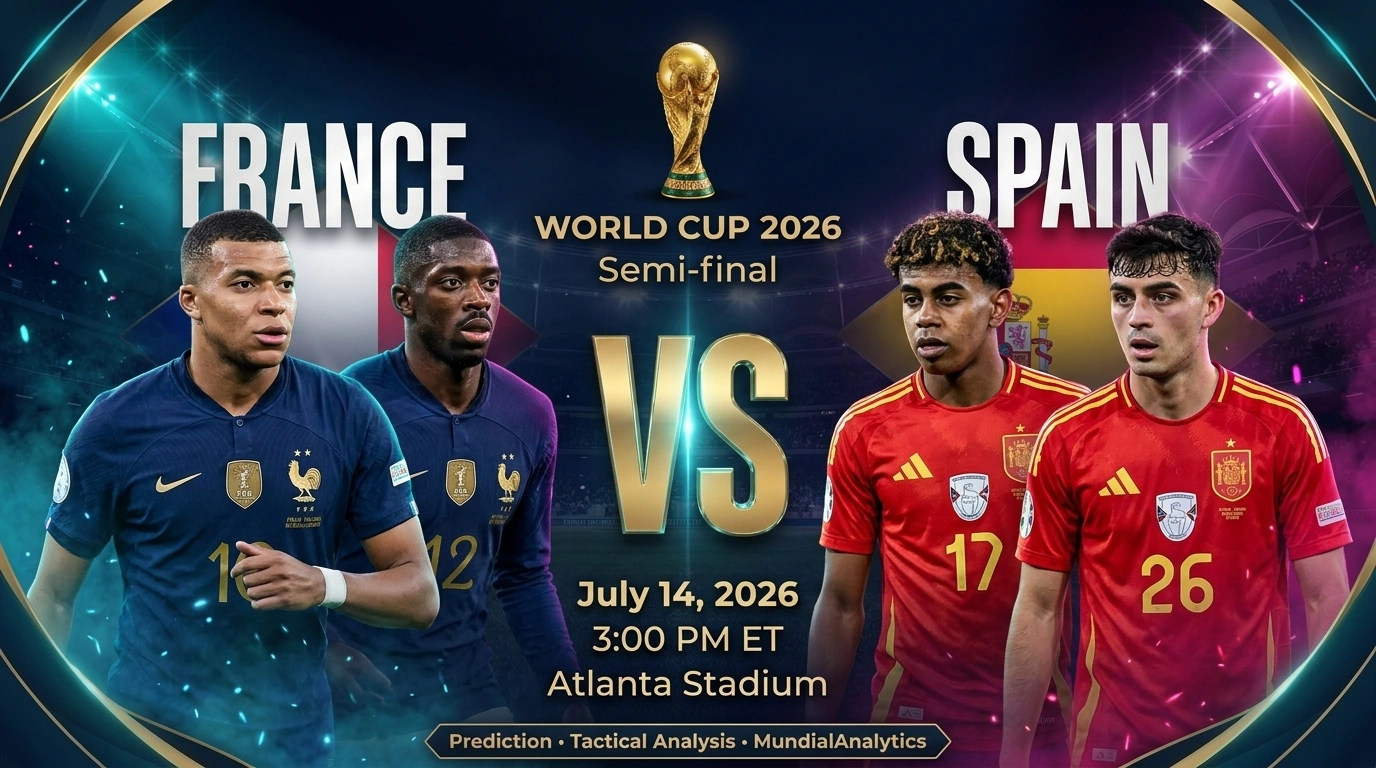
Spain: positional control and progressive width
Spain's build-up is built around a back four that morphs into a three-man first line when one full-back pushes high and the opposite centre-back shifts wide to cover. Rodri anchors the base, while Pedri and another interior midfielder operate in the half-spaces, receiving between lines and linking play toward the wide zones where Yamal and the opposite winger stretch the pitch. The defining feature of Spain's possession game in this tournament has been its purpose: every pass sequence is designed to either draw a French defender out of position or create an overload on one flank.
When Yamal receives one-on-one against a full-back, Spain's midfielders have already positioned themselves to recycle the ball quickly if the initial attack stalls — ensuring that a failed dribble does not become a French counter. This rest-defence discipline is the evolution that separates this Spain side from earlier generations that were occasionally vulnerable to rapid transitions. Luis de la Fuente has built a system where possession and defensive security are not trade-offs but complementary objectives.
Spain's pressing is coordinated and aggressive in the first phase. They look to force turnovers in France's defensive third, particularly when French centre-backs receive under pressure from Morata's screening runs. If Spain score first, expect them to maintain possession rhythms rather than sitting deep — their coaching staff trusts the structure to limit counter-attacking opportunities even when both full-backs are advanced. The vulnerability, when it surfaces, is in the seconds immediately after a turnover in advanced positions: if Pedri or an advanced full-back loses the ball in France's half, the space behind Spain's midfield line becomes exploitable by Mbappé's acceleration.
France: compact block, Mbappé as the release valve
France's out-of-possession shape typically settles into a 4–4–2 or 4–4–1–1 mid-block, with Mbappé and the nearest supporting forward cutting passing lanes into midfield while the wide midfielders tuck in to protect the half-spaces. The back four stays compact, rarely stepping into challenges they cannot win, and the priority is always the same: deny Pedri and Rodri the easy progression pass, then win the ball and get it to Mbappé or Dembélé as quickly as possible.
Mbappé's role in this system is not simply finishing — it is structural. He is the player who turns France's defensive phases into attacking ones, often with a single carry or pass that bypasses three or four Spanish players. His ability to attack the channel behind Spain's advanced full-backs, combine with Dembélé and France's advancing midfielders, or finish from tight angles gives France a multi-dimensional counter threat that few teams in the tournament can replicate. When Mbappé is locked in, France do not need possession to control the match's decisive moments.
Tchouaméni and Zaïre-Emery give France a blend of defensive range and progressive passing. Their first task is to close central access; their second is to release Mbappé or Dembélé quickly after regains.
France's trade-off is clear: they accept long periods without the ball, trusting their organisation and individual quality to produce two or three high-quality chances. The risk is cumulative fatigue and set-piece pressure — Spain's corner count and final-third entries will test France's concentration over 90 minutes, and even elite blocks eventually concede when the volume is high enough. Deschamps' challenge is calibrating the defensive line height: too deep, and Spain pin them in their own half with endless circulation; too high, and Morata's runs in behind become dangerous.
Coaching philosophies and likely in-game adjustments
Luis de la Fuente has shown flexibility within Spain's possession framework. If France's block is denying central penetration, Spain can shift to wider overloads with both full-backs pushing high, or introduce a more direct striker to attack crosses. He may also adjust the pressing trigger — sitting slightly deeper after the 60th minute to protect against Mbappé's counter runs if Spain hold a lead. The key adjustment Spain must make is managing the transition moments: every turnover in France's half is a potential Mbappé chance, and Spain's full-backs must balance their attacking contribution with defensive recovery speed.
Didier Deschamps, meanwhile, face the challenge of calibrating France's defensive approach against the best possession team in the tournament. The likely compromise is a mid-block that steps aggressively when the ball is wide but drops quickly when Pedri receives in central space. Substitutions will probably focus on fresh legs for the wide counter-attacking roles — preserving Mbappé's explosiveness and Dembélé's dribbling threat for the moments when Spain are most stretched. If France score first, expect them to drop deeper and invite Spain forward, turning the semi-final into a test of Spanish patience and composure against a lead-defending machine with extensive knockout experience.