

Old Rivals. New World.
 England
 Argentina
England vs Argentina Prediction
England vs Argentina at Atlanta Stadium is a semi-final freighted with history and immediate consequence. European structure meets South American invention: Harry Kane and Jude Bellingham against Lionel Messi and Enzo Fernández, with a place in the July 19 final at New York New Jersey Stadium waiting for the side that handles the pressure best.
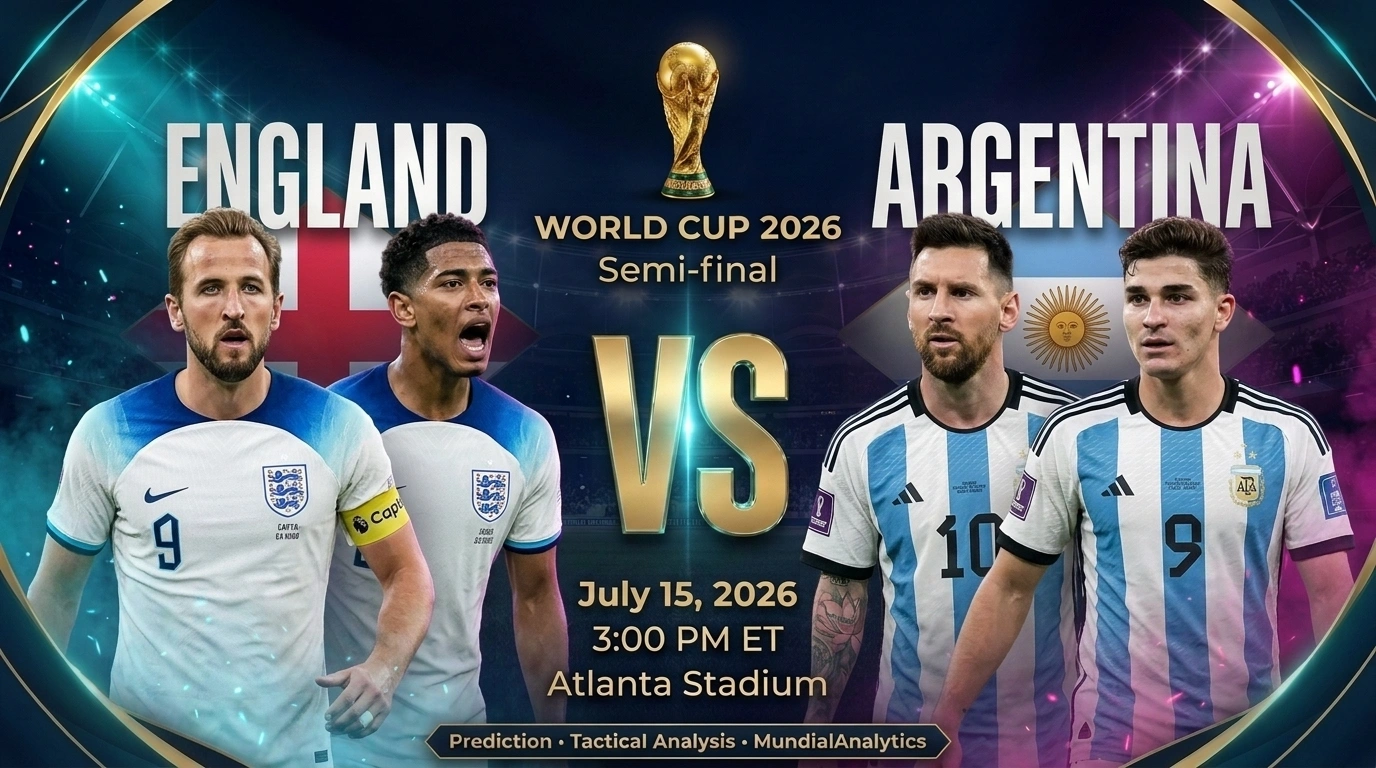
England vs Argentina Semi-final Details
Why This Semi-final Matters
Semi-finals are where World Cups stop being tournaments and become legacies. England arrive in Atlanta carrying the accumulated weight of a nation that has waited decades for a men's world title, now within two matches of ending that drought on American soil. Argentina arrive as defending champions — a status that carries its own gravitational pull — led by Lionel Messi in what may be his final World Cup campaign, seeking to add another chapter to a rivalry that has produced some of the most emotionally charged matches in football history.
The stakes are not abstract. FIFA's official bracket routes the England vs Argentina winner directly into the World Cup 2026 final at New York New Jersey Stadium on July 19. One win separates either side from the sport's ultimate prize. For England, that means converting a generation of talent — Kane, Bellingham, Foden, Saka — into the kind of defining night that previous squads could not quite deliver at this stage. For Argentina, it means proving that the institutional knowledge of winning in Qatar still burns bright, even as Messi's minutes are managed and the physical toll of back-to-back extra-time quarter-finals accumulates.
The tactical contrast is compelling in ways that transcend nostalgia. England bring layered possession, set-piece superiority and the physical authority of a European side that has grown into the tournament rather than peaked too early. Their 3–2 win over Mexico in the Round of 16 and 2–1 extra-time quarter-final victory over Norway demonstrated a team comfortable in chaos and patient in tight games. Argentina bring individual brilliance embedded in collective understanding — Messi's vision, Julián Álvarez's movement, Enzo Fernández's distribution — combined with a South American pragmatism that has produced two consecutive 3–2 knockout wins against Egypt and a gruelling extra-time triumph over Switzerland.
Atlanta Stadium adds a distinct environmental layer. The July afternoon kickoff at 3:00 PM ET means warm conditions and a fast surface — factors that could accelerate fatigue for a Argentina side that played 120 minutes against Switzerland just days earlier, but also conditions where England's athleticism and set-piece routines could become decisive weapons. The venue will host one of the most anticipated semi-finals in recent World Cup memory, in front of a crowd that blends passionate South American support, England's travelling army and the neutral American audience that has embraced this expanded tournament format.
For anyone searching for an England vs Argentina prediction, preview, betting tips or expected lineups, the essential insight is that this is a genuine heavyweight collision rather than a mismatch. Argentina are favoured because their knockout pedigree, Messi's influence and Enzo Fernández's midfield control give them more paths to win tight games. But England have the squad depth, aerial threat and tactical flexibility to impose a different kind of match — one where physical duels, set pieces and Bellingham's box-to-box energy tilt the balance. The semi-final will be decided by whether England can convert territorial advantage into goals before Argentina's transition game and Messi's genius produce the moments that have defined this rivalry for forty years.
The emotional register of this fixture cannot be separated from its tactical content. Every England player grew up hearing about 1986; every Argentina player understands what beating England means to their support base. That psychological charge does not replace preparation, but it amplifies every mistake and magnifies every moment of quality. Semi-finals between these nations are rarely comfortable. Atlanta promises another chapter in that tradition.
How England and Argentina Reached the Last Four
England: momentum through adversity
Group stage: England navigated the expanded 2026 group format without losing their structural identity. Thomas Tuchel's side combined controlled build-up with selective acceleration through Bukayo Saka and Phil Foden, while Declan Rice and Jude Bellingham provided the defensive platform that allowed full-backs to push high. The group stage established England as a team that could dominate territory without becoming predictable — a quality that matters enormously in knockout football.
Round of 32: England's first knockout test asked them to manage a game they were expected to control. They did so with increasing attacking intent: Bellingham's forward runs, Foden's movement between the lines and Harry Kane's hold-up play created overloads that the opponent could not sustain for 90 minutes. The scoreline was professional rather than spectacular — exactly the profile of a team learning to win without needing to overwhelm opponents.
Round of 16 vs Mexico: The 3–2 victory was the performance that confirmed England's tournament credentials. Mexico pushed hard in a hostile, high-intensity environment and the game swung repeatedly, but Kane's link play, Bellingham's energy and Foden's decisive contributions proved England can win when margins are narrow and the atmosphere is volatile. Expected-goals data backed the eye test: multiple big chances created, a team increasingly comfortable in chaos.
Quarter-final vs Norway: England beat Norway 2–1 after extra time in Miami to reach their first World Cup semi-final since 2018. The match tested England's patience against Erling Haaland's directness and Martin Ødegaard's creativity, but Tuchel's side controlled key phases, managed rest-defence intelligently and found enough quality in the final third to advance. The win validated England's status as European contenders without requiring a statement performance.
England's arc through the tournament has been one of growing authority tempered by realism. They have not overwhelmed every opponent, but they have found ways to win when the game state demanded discipline. That profile — quality with pragmatism — is precisely what a semi-final against Argentina requires.
Argentina: champions tested, not broken
Group stage: Argentina topped their group with the authority expected of defending champions. Lionel Scaloni's side controlled possession in all three fixtures, rotated intelligently without losing tactical identity, and finished with a healthy goal difference that reflected attacking depth beyond Messi alone. Julián Álvarez's movement and Enzo Fernández's distribution established the platform that has carried through every knockout round.
Round of 32: Argentina's first knockout assignment asked them to manage expectation against an opponent willing to defend deep and counter quickly. They controlled the majority of phases, created chances through Messi and Lautaro combinations, and demonstrated the rotation flexibility that allows Scaloni to manage minutes without changing the system's logic.
Round of 16 vs Egypt: The 3–2 scoreline exposed Argentina's recurring vulnerability: rest-defence on transitions. Egypt found joy attacking the space behind Argentina's advancing full-backs, and the match required Messi's intervention and Emiliano Martínez's composure to see Argentina through. The win was valuable precisely because it was uncomfortable — a reminder that even champions must solve problems under pressure.
Quarter-final vs Switzerland: Argentina defeated Switzerland 3–1 after extra time in Kansas City — a tie that demanded 120 minutes of concentration against a side built for penalty-shootout resilience. The victory confirmed Argentina's ability to win when the margins are narrow and the clock runs long, but it also added significant physical load ahead of Atlanta. Scaloni's squad management between the quarter-final and semi-final will be one of the tournament's most scrutinised decisions.
Argentina's road to Atlanta has been defined by championship mentality rather than comfort. They have been tested in consecutive knockout rounds and answered every time — but the cumulative cost of extra time and high-intensity wins is a live factor heading into the semi-final against England's own recovery demands and set-piece threat.
England vs Argentina: Historical World Cup Context
Verified World Cup meetings and semi-final histories that frame the emotional and tactical stakes in Atlanta.
World Cup head-to-head: three meetings, zero comfort
England and Argentina have met at three World Cups, producing two Argentina advances in knockout matches and one England group-stage victory. The rivalry's defining chapter arrived in Mexico City on 22 June 1986, when Argentina beat England 2–1 in the quarter-finals. Diego Maradona scored twice — the first with his hand, the second with a run that remains among the greatest individual goals in World Cup history. The match fused sporting controversy with raw genius, and it permanently altered how both nations perceive this fixture. For England, 1986 is a wound that never fully closed; for Argentina, it is foundational mythology.
Twelve years later in Saint-Étienne, the rivals met again in the 1998 Round of 16. Argentina and England drew 2–2 after 90 minutes — Michael Owen's sensational solo goal for England, Gabriel Batistuta and Javier Zanetti for Argentina — before Argentina prevailed 4–3 on penalties. David Beckham's red card for a foul on Diego Simeone became the English talking point, but the match itself was open, chaotic and emotionally exhausting. Argentina's penalty-shootout win extended a World Cup record that England have never managed to reverse.
The most recent World Cup meeting came in the 2002 group stage in Sapporo, where England beat Argentina 1–0. David Beckham converted a first-half penalty — retribution for 1998 in the eyes of England fans — and England defended the lead with disciplined organisation. The result placed Argentina under severe pressure in a group they ultimately failed to escape and gave England a rare World Cup satisfaction against their rivals, though the broader rivalry balance remained heavily tilted toward South America in knockout contexts.
Semi-final histories: paths to glory and heartbreak
England's World Cup semi-final history is a catalogue of near-misses. In 1990 at Italia '90, England lost 4–3 on penalties to West Germany after a 1–1 draw — Gazza's tears becoming the enduring image of a generation that came close but could not cross the line. In 2018 in Russia, England lost 2–1 to Croatia in Moscow after taking an early lead, a defeat that felt like progress at the time but still left the semi-final barrier intact. England have never reached a World Cup final on foreign soil. Atlanta represents the best opportunity in a generation to rewrite that statistic.
Argentina's semi-final history offers a contrasting emotional spectrum. In 1986, they beat Belgium 2–0 in Mexico City before defeating West Germany in the final — the Maradona World Cup. In 1990, they edged Italy on penalties in Naples before losing the final to West Germany. In 2014, they beat the Netherlands on penalties in São Paulo before falling to Germany in extra time in the final. In 2022, they defeated Croatia 3–0 in Lusail before winning the final against France on penalties. Argentina understand semi-final nights in ways England are still learning: they have won four of their last five World Cup semi-finals and converted three of those into world titles.
That institutional memory matters in Atlanta. Argentina know how to manage the emotional temperature of a semi-final — when to press, when to absorb, when to trust Messi to decide the tie. England know they have the talent to win, but their semi-final record suggests the psychological hurdle remains real. The historical context does not predict the result, but it explains why neither squad can treat this as a ordinary knockout match. For England, it is a chance to exorcise decades of frustration; for Argentina, it is a chance to prove that 2022 was not a closing chapter but the middle of one.
England vs Argentina: Tournament Stats Snapshot
Editorial trend analysis based on World Cup 2026 match data. Advanced metrics such as expected goals should be read as directional profiles rather than official FIFA figures.
How England and Argentina Match Up Tactically
England: layered build-up, set-piece weaponry
England's build-up typically flows through a back four that morphs into a back three when one full-back pushes high and the opposite centre-back shifts wide to cover. Declan Rice anchors the base as the single pivot, while Jude Bellingham and Phil Foden operate in the half-spaces — Bellingham with his box-to-box runs, Foden with his movement between the lines. Bukayo Saka and Anthony Gordon (or equivalent wide forwards) stretch the pitch horizontally, creating the overloads that allow England to enter the final third with numbers.
Harry Kane's role as a link striker remains the tactical fulcrum. He drops between Argentina's lines to receive, turns and releases Foden or Bellingham into space, or holds the ball to allow Saka and the overlapping full-back to join the attack. Against a compact Argentina block, Kane's hold-up play and ability to win fouls in dangerous areas may be as valuable as any goal. England's set-piece superiority — honed across multiple tournaments — gives them a secondary scoring route that Argentina must respect even when open play is congested.
Out of possession, England press in coordinated triggers, particularly when Argentina's centre-backs receive under pressure from Kane's screening runs. The risk is rest-defence: if both full-backs advance and Bellingham pushes high simultaneously, the space behind England's midfield becomes exploitable by Messi's release passes and Lautaro's runs. Tuchel's semi-final game plan will likely involve calibrating pressing intensity — aggressive in the first half to establish territory, slightly more conservative after the hour mark if Argentina's transition threat grows.
Argentina: Messi-centric structure, transition threat
Argentina's build-up flows through a back four that can morph into a back three when one full-back inverts alongside Enzo Fernández. Enzo has become the connective tissue — receiving under pressure, turning play quickly, and finding Messi in pockets between the lines where few defenders can follow without creating space elsewhere. Rodrigo De Paul provides the combative edge and ball-winning that allows Enzo and Alexis Mac Allister to play forward, while the front three of Messi and Julián Álvarez, supported by midfield runners combine movement, pressing and finishing.
Messi's role is not simply creative — it is structural. He draws multiple defenders, creates the conditions for Julián Álvarez's channel runs, and remains capable of deciding a semi-final with a free kick, a through ball or a moment of close control in the box. Even at reduced mobility compared to previous World Cups, his decision-making in tight spaces remains unmatched. Argentina's best attacking sequences typically involve three or four passes from Enzo to Messi to Julián Álvarez — a chain England's midfield must disrupt repeatedly.
The structural vulnerability that appeared against Egypt and Switzerland is rest-defence on transitions. When both full-backs push high and the midfield steps up simultaneously, the space behind Argentina's centre-backs becomes exploitable. England's best route to hurting Argentina is to win the ball in those transitional moments and attack the space before Enzo or De Paul can recover — Saka's pace and Kane's runs in behind are tailor-made for that role. Argentina accept this trade-off because their championship model prioritises control and Messi's influence over defensive perfection.
Coaching philosophies and likely in-game adjustments
Thomas Tuchel has shown flexibility within England's possession framework across multiple tournaments. Against Argentina's compact shape, he may push Bellingham higher to disrupt Enzo's receiving angles, or introduce fresh wide players after 60 minutes to maintain the intensity that extra-time-weary opponents struggle to match. Set-piece routines will be rehearsed extensively — England know that dead-ball situations may provide the cleanest route to a goal against organised defending.
Lionel Scaloni has repeatedly demonstrated a willingness to adjust within games, particularly by changing the roles of his wide forwards and the intensity of his press. Against England's physicality and set-piece threat, he may sit slightly deeper in the first half, limit Messi's defensive workload, and introduce pace from the bench if Argentina need to chase the game. His squad management between the Switzerland quarter-final and the semi-final — who starts, who is rested, how Messi's minutes are distributed — may be as influential as any tactical instruction.
The Atlanta heat adds a dimension both coaches must manage. England's superior squad depth gives them more options to rotate energy-intensive roles, particularly Bellingham's box-to-box workload. Both teams played 120 minutes in their quarter-finals, so recovery and squad depth are important on both sides. Substitutions could decide this semi-final more than in a typical European knockout tie — fresh legs against tired legs in the final 25 minutes may be the decisive variable.
Key Individual Battles
Bellingham vs Enzo Fernández: engine vs metronome
The central duel that defines the match's tactical narrative. Bellingham's job is to disrupt Enzo's rhythm, win second balls in front of Argentina's defence and drive forward when England win possession. Enzo's job is the opposite: receive under pressure, play forward quickly, and find Messi in pockets where England's structure cannot follow without creating gaps. Whichever midfielder imposes their tempo more consistently will tilt the semi-final. Bellingham's physical advantage and England's fresher legs give him an edge in duels; Enzo's passing range and press resistance give Argentina an edge in circulation.
Messi vs England's centre-backs
The defining duel of the match. England's centre-back pairing — likely John Stones and Marc Guéhi or equivalent — must track Messi's movement between the lines without being drawn out of position. If Argentina isolate Messi in the right half-space often enough, England's compact block will be stretched and gaps will appear for Julián Álvarez and Argentina's midfield runners. If England's centre-backs keep Messi in front of them, deny service into the box and limit fouls in dangerous areas, Argentina's attacking foundation weakens. One moment of Messi genius can override ninety minutes of disciplined defending — England know this from history.
Kane vs Cristian Romero and Nicolás Otamendi
Harry Kane's hold-up play, link-up combinations and movement in the box face Argentina's experienced centre-back pairing. Kane's ability to drop between lines and release Foden or Bellingham is England's most reliable weapon against deep blocks. Romero and Otamendi must communicate constantly, track Kane's runs even when the ball is on the opposite flank, and win aerial duels on England's set pieces. If Kane finds space or wins fouls in dangerous areas, England's attack becomes coherent; if Argentina's centre-backs keep him quiet, England may have territory without penetration.
Saka vs Nicolás Tagliafico
Bukayo Saka has been England's most consistent wide outlet in this tournament, combining dribbling skill with increasingly mature decision-making. Tagliafico — Argentina's left-back — must decide between showing Saka inside into traffic or forcing him wide and risking quality crosses. If Saka wins this matchup repeatedly, England's wide overloads become genuinely threatening. If Tagliafico and De Paul combine to double-team Saka effectively, England's primary wide route is neutralised and the attack becomes more central and predictable.
Lautaro Martínez vs England's defensive midfield screen
Julián Álvarez's movement in the channels is Argentina's most reliable weapon against deep blocks. His ability to peel off the shoulder of the last defender and arrive on Messi's through balls creates one-on-one chances that break organised defences. Declan Rice and Bellingham must track his runs even when the ball is elsewhere — one moment of lost concentration could be decisive. Julián Álvarez's pressing intensity also forces errors in England's build-up, making him influential in both phases of the game.
Pickford vs Emiliano Martínez: goalkeeper psychology
Both goalkeepers have tournament-winning pedigree — Emiliano Martínez from Qatar 2022, Jordan Pickford from England's deep runs in 2018 and 2024. In a semi-final where fine margins decide everything, shot-stopping quality and command of the penalty area on set pieces matter enormously. Emiliano Martínez's reputation in high-pressure moments provides Argentina a psychological edge; Pickford's distribution and reflex saves give England a platform to play higher when needed. One save at 85 minutes could be the difference between a final appearance and another semi-final heartbreak.
Key Players and Their Expected Impact
England
- Jude Bellingham — Scored both goals in the 2–1 extra-time victory over Norway. Reuters reported that Bellingham and Harry Kane have combined for 12 of England's 13 tournament goals, underlining how dependent England have become on their biggest match-winners.
- Harry Kane — England's captain and central reference point. His movement, finishing and ability to link attacks remain essential even when he is not the scorer.
- Elliot Anderson — England Football's tournament data ranked him first in the squad for interceptions, tackles, possession won, duels won and line-breaking passes before the quarter-final. His work could be crucial in limiting Enzo Fernández and Messi's central access.
- Bukayo Saka — Gives England their clearest one-on-one threat and can force Argentina's left side to defend deeper than it prefers.
- Jordan Pickford — England may need high-value saves rather than constant shot volume. His communication and penalty-shootout experience remain major assets.
More on the squad: England analysis
Argentina
- Lionel Messi — At 39, he remains Argentina's decisive creator. Reuters noted that he inspired the late 3–2 comeback against Egypt after Argentina trailed 2–0 with eleven minutes remaining.
- Julián Álvarez — Retained his place for the Switzerland quarter-final and scored in extra time. His pressing, channel movement and willingness to run beyond Messi give Argentina vertical threat.
- Enzo Fernández — Argentina's main progression midfielder. England must prevent him from receiving cleanly and finding Messi between the lines.
- Rodrigo De Paul — Provides intensity, counter-pressing and defensive coverage around Messi. His duel with Bellingham will shape the physical rhythm of the match.
- Emiliano Martínez — Argentina's goalkeeper combines elite shot-stopping with proven authority in extra time and penalty situations.
More on the squad: Argentina analysis
Expected Lineups (Provisional)
These are editorial projections based on current tournament usage. Both teams played 120 minutes in the quarter-finals, so recovery assessments may change the final selections.
England (4-2-3-1)
                         Pickford

                   RB      CB      CB      LB

                      Anderson     Rice

                    Saka   Bellingham   LW

                            Kane
- GK: Jordan Pickford
- DEF: final back four depends on the latest status of Marc Guéhi, Reece James and other tournament regulars
- MID: Elliot Anderson and Declan Rice behind Jude Bellingham
- ATT: Bukayo Saka, Harry Kane and one additional wide forward
Argentina (4-4-2 / 4-3-1-2)
                    Emiliano Martínez

               Molina   Romero   Lisandro   Tagliafico

                Paredes   De Paul   Enzo   Mac Allister

                         Messi
                      Julián Álvarez
- GK: Emiliano Martínez
- DEF: Nahuel Molina, Cristian Romero, Lisandro Martínez, Nicolás Tagliafico
- MID: Leandro Paredes, Rodrigo De Paul, Enzo Fernández, Alexis Mac Allister
- ATT: Lionel Messi and Julián Álvarez
England vs Argentina Injuries and Availability
England received positive fitness news before the Norway quarter-final when Declan Rice and Marc Guéhi returned to full training after working separately earlier in the week. Reece James had been managing a hamstring problem and had missed three matches. Their condition after the 120-minute quarter-final must still be monitored.
Jude Bellingham and Harry Kane carried England's attack into the semi-finals, with Bellingham scoring both goals against Norway. Thomas Tuchel has publicly said England must improve their attacking play and involve more players, although he praised both players for repeatedly delivering in decisive moments.
Argentina used the same starting XI against Switzerland that had begun the 3–2 comeback victory over Egypt: Emiliano Martínez; Nahuel Molina, Cristian Romero, Lisandro Martínez, Nicolás Tagliafico; Leandro Paredes, Rodrigo De Paul, Enzo Fernández, Alexis Mac Allister; Lionel Messi and Julián Álvarez. Álvarez and Lisandro Martínez scored in extra time in the 3–1 quarter-final win.
Both teams played 120 minutes in their quarter-finals, so recovery rather than a one-sided freshness advantage is the central issue. No unverified injury or suspension claim should be treated as final. Check the FIFA Match Centre and official federation channels for the confirmed squads and starting lineups.
Expected Match Scenario
In the most plausible tactical scenarios, Argentina settle into 55–58% possession with England defending in a compact 4–4–2 mid-block that shifts quickly into a 4–3–3 when pressing. Argentina's build-up flows through Enzo Fernández into Messi and Lautaro combinations, while England rely on Kane's hold-up play, Saka's wide runs and set-piece routines to create their clearest chances. The first half likely sees Argentina control rhythm without necessarily breaking England's structure — a pattern familiar from Argentina's knockout wins over Egypt and Switzerland.
Our editorial scenario analysis rates the probability of extra time as moderate — a meaningful but unquantified level — because both sides have shown the ability to win tight games in regulation, but also because semi-final caution and defensive organisation can suppress scoring rates. In simulated paths where England score first from a set piece or Saka's wide play, the win tendency shifts toward a controlled 2–1 or 1–0. In paths where Messi scores first or equalises after the 60th minute, the game becomes increasingly open and Argentina's transition threat grows.
The tactical projection gives England the higher chance-creation floor from set pieces and wide overloads, but Argentina's clearest chances may come from fewer, faster moments — Messi free kicks, Julián Álvarez's channel runs, De Paul's driving runs. England can create more; Argentina can make one clean sequence feel just as valuable as fifteen minutes of pressure. That asymmetry is the central tension of this semi-final.
The 60th–80th minute window looks particularly decisive. Because both teams played extra time, the decisive question is which squad recovers better and manages its substitutions more effectively. Conversely, if the score is level entering this phase, Messi's managed minutes often produce his most influential contributions — fresh enough to exploit tired legs, experienced enough to avoid the mistakes that semi-finals punish. Tuchel's substitution timing and Scaloni's Messi deployment may decide the tie before the final whistle.
Set pieces remain England's most reliable path to a goal against Argentina's organised block. Corner routines, free-kick delivery from Foden or Trippier, and Kane's movement on second balls could produce the moment that separates the sides. Argentina must be disciplined in conceding fouls in dangerous areas and organised in defending aerial threats — England's set-piece record in this tournament suggests at least one big chance from dead-ball situations is likely.
England vs Argentina Betting Analysis
Editorial analysis only — no guarantees, no financial advice. Always check live markets and limits, and never bet more than you can afford to lose.
Argentina to qualify aligns with their knockout pedigree, Messi's influence and semi-final experience, while acknowledging England's set-piece strength and squad depth.
Argentina or Draw reflects confidence in Argentina's floor — they rarely lose control entirely in knockout games — without requiring a regulation-time win.
England +1 can appeal if markets price Argentina as overwhelming favourites, given England's set-piece threat and Bellingham's ability to keep any tie competitive.
Over 2.5 goals has a logical case: both sides have scored three in recent knockout wins and both have defensive vulnerabilities on transitions, though semi-final caution can suppress totals.
BTTS (Yes) follows the tactical logic — Argentina will score from possession and Messi moments, and England have the weapons to punish at least once from set pieces or wide play. BTTS (No) leans on a tight, low-scoring semi-final decided by a single moment.
Messi shots and assists, Kane anytime scorer, Bellingham tackles, Julián Álvarez goalscorer, or Saka shots on target are markets that map directly to the key individual battles — not random name-picking.
The core idea: markets typically price Argentina correctly as slight favourites, but may underestimate England's set-piece ceiling and England's set-piece ceiling and Bellingham's current form. Strategies that back Argentina to qualify while treating large handicaps with caution better match the real risk profile of this semi-final.
Exact Score Forecast & Confidence
Primary exact-score forecast: Argentina 2–1 England
Editorial confidence in Argentina qualifying: ~56% (editorial estimate, not market odds).
This score reflects a script where Argentina's possession control and Messi's influence produce sustained pressure and an opening goal — likely through a Lautaro movement or Messi free kick — before England respond through a set piece or Kane's hold-up play leading to a Saka or Foden finish. Argentina's second goal arrives in the second half, either from a period of intense territorial pressure that breaks England's block or a transition moment when Bellingham's forward push leaves space for Messi to release Lautaro.
Alternative scenario: 1–1 after 90 minutes decided in extra time or penalties, where Emiliano Martínez's shootout pedigree becomes decisive. A comfortable Argentina win by three or more goals looks unlikely given England's defensive structure and set-piece threat; a 1–0 England win is plausible if Tuchel's side convert a set piece and manage game state expertly, but Argentina's knockout scoring record makes that the less likely path.
Expert Verdict on England vs Argentina
England enter this semi-final as the side with more physical freshness and the clearest secondary scoring route through set pieces. Harry Kane, Jude Bellingham and Phil Foden form a spine that has grown into the tournament, and the 2–1 quarter-final win over Norway demonstrated that this England side can win tight games against quality opposition without needing to overwhelm opponents. Jordan Pickford's experience in high-pressure knockout matches remains a valuable platform for England.
Argentina, however, are not a team that needs to dominate to win. Their a 3–2 comeback against Egypt and a 3–1 extra-time victory over Switzerland — confirmed a championship mentality that England are still building. Lionel Messi remains capable of deciding a World Cup semi-final with a single sequence, Enzo Fernández's midfield control gives Argentina the platform to manage tempo, and Julián Álvarez's movement provides the goal threat that turns possession into outcomes. Argentina have won their last four World Cup semi-finals; England lost at this stage in 1990 and 2018.
The verdict: Argentina are logical slight favourites because their knockout pedigree, Messi's influence and semi-final experience provide more paths to victory in a tight game. England have the tools to win — set pieces, Bellingham's energy, Kane's link play — but must convert those advantages before Argentina's transition game and Messi's genius produce the moments that have defined this rivalry. Expect a competitive, emotionally charged semi-final that Argentina edge 2–1, sending Messi one step closer to a final in New York while England confront another near-miss on the sport's biggest stage. The margin will be narrow, the stakes enormous, and the history inescapable.
England vs Argentina Semi-final FAQ
When and where is England vs Argentina played?
FIFA's official schedule lists the England vs Argentina semi-final on July 15, 2026 at Atlanta Stadium in Atlanta, Georgia, with kickoff at 3:00 PM Eastern Time (ET).
What stage of the World Cup is this?
England vs Argentina is a semi-final — Match M102 on FIFA's official fixture list. The winner advances to the World Cup 2026 final at New York New Jersey Stadium on July 19.
Who plays the England vs Argentina winner in the final?
The winner of this tie meets the victor of the other semi-final at New York New Jersey Stadium on July 19, per FIFA's official bracket.
What is the England vs Argentina score prediction?
Our editorial forecast is Argentina 2–1 England, reflecting Argentina's knockout pedigree and Messi's influence balanced against England's set-piece strength and physical freshness.
Who is the favourite in our model?
Argentina hold a slight edge with approximately 56% editorial confidence in qualifying. Messi's influence, Enzo Fernández's control and Argentina's semi-final history prevent England from being installed as favourites despite their quarter-final freshness advantage.
How did England and Argentina reach the semi-finals?
England beat Norway 2–1 after extra time in the quarter-finals following a 3–2 Round of 16 win over Mexico. Argentina defeated Switzerland 3–1 after extra time in the quarter-finals, following a 3–2 Round of 16 victory over Egypt.
What is the historic England vs Argentina World Cup record?
Verified meetings include Argentina's 2–1 quarter-final win in 1986, a 2–2 draw won on penalties by Argentina in the 1998 Round of 16, and England's 1–0 group-stage win in 2002 through a David Beckham penalty.
How reliable are the predicted lineups?
They are based on previous matches and tactical patterns but are not official. Confirmed starting XIs are published by FIFA and federations 60–90 minutes before kickoff.
Where can I read deeper team analysis?
See our England and Argentina team pages, plus the full Teams hub, favorites tracker and tactical trends coverage.
Where can I read more World Cup 2026 knockout previews?
Visit the predictions hub for quarter-final recaps including Norway vs England and Argentina vs Switzerland, plus the tournament format guide.
Editorial note: Match details and results were checked against FIFA's official schedule and Match Centre. Current England and Argentina team news was checked against Reuters and England Football reporting published after the quarter-finals. Predictions, confidence percentages and projected lineups are editorial estimates rather than official data or bookmaker odds.
More World Cup 2026 Semi-final Resources
Continue on the predictions hub, explore tournament favorites and read our tactical trends report for the knockout phase. For the road to Atlanta, revisit the quarter-final previews: Norway vs England and Argentina vs Switzerland. Deep-dive squad analysis is available on the England and Argentina team pages, with the full Teams directory and format guide for bracket context.