

Group C Qualification
Morocco are in control, but a win removes uncertainty and keeps pressure on Brazil in the race for first place.
World Cup 2026 Matchday 3 — Final Group Stage Match
 Morocco
 Haiti
HaitiMorocco vs Haiti is not just a closing Group C fixture; it is the match that can confirm Morocco's knockout-stage position and potentially keep them in the race for first place. Morocco enter unbeaten after drawing Brazil 1-1 and beating Scotland 1-0, while Haiti arrive under severe pressure after defeats to Scotland and Brazil.
Editorial Win Probability
Editorial probability estimate, not betting odds.
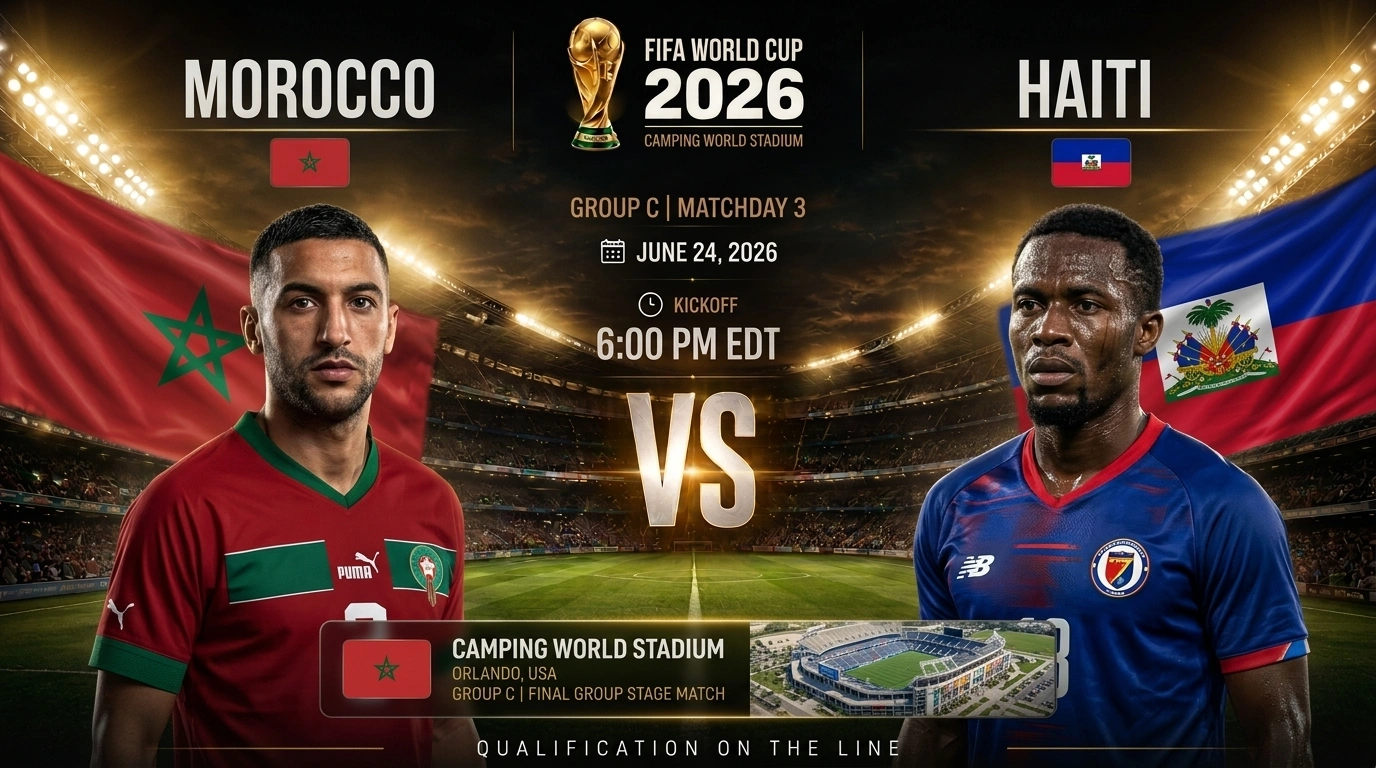
Morocco vs Haiti kicks off at 6:00 PM EDT on June 24, 2026 in Group C at Camping World Stadium, Orlando. Morocco come into the final round on 4 points, level with Brazil at the top of the group, while Haiti have 0 points and a difficult goal-difference situation after two defeats.
The strongest Morocco vs Haiti prediction starts with the state of Group C. Morocco have done exactly what serious tournament teams do in difficult groups: they have collected points without losing tactical discipline. A 1-1 draw against Brazil gave them credibility immediately, and the 1-0 win over Scotland gave them the margin they needed before the final round. Four points from those two matches puts Morocco in control of their own route into the knockout stage.
Haiti's campaign has been far more punishing. The 1-0 defeat to Scotland was damaging because it came in the match where Haiti most likely needed points. The 3-0 loss to Brazil then widened the gap in both confidence and goal difference. Haiti still have incentive to play with pride and intensity, but their tournament position forces them to take risks against one of the most organised defensive teams in Group C.
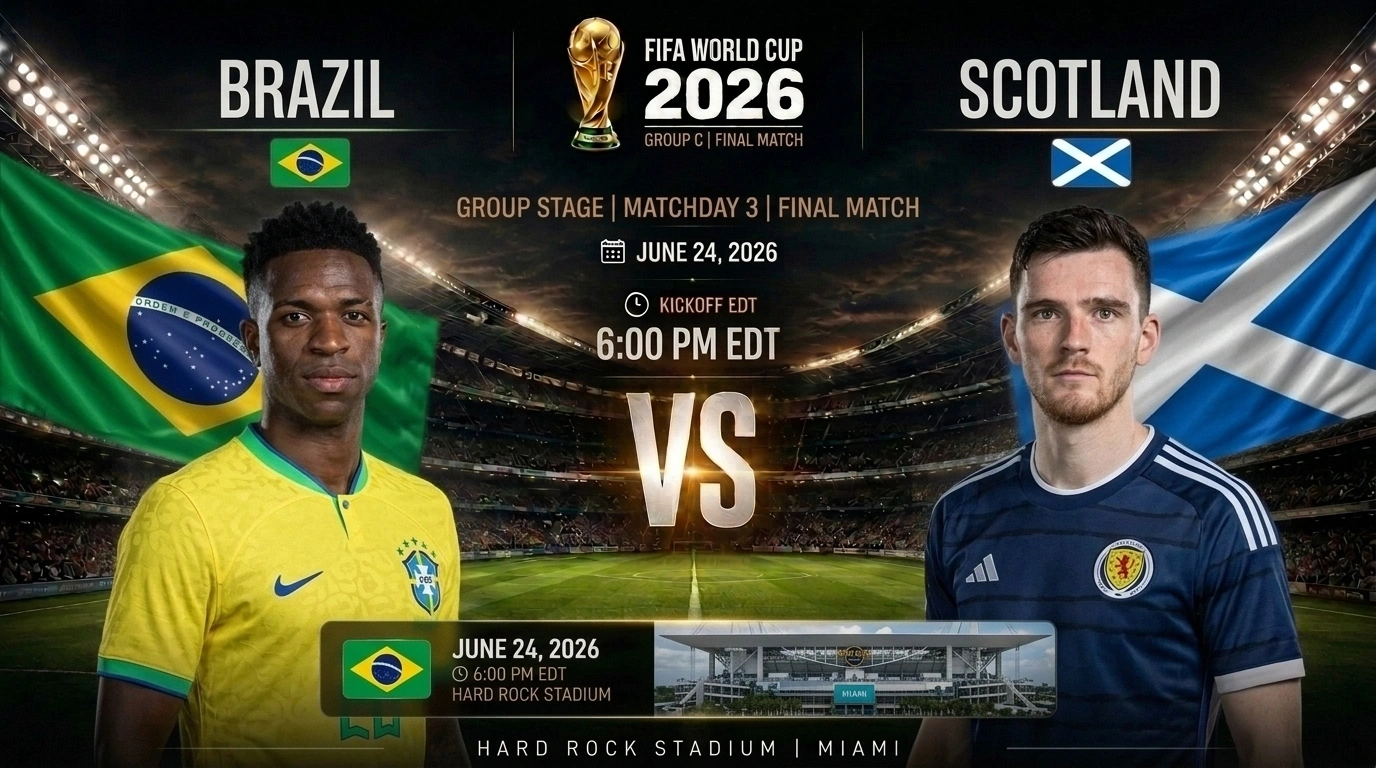
The simultaneous fixture, Brazil vs Scotland, matters. Morocco cannot treat this as a ceremonial match because top spot remains relevant, and even the difference between first and second can reshape the Round of 32 route. That creates an interesting tactical tension: Morocco do not need chaos, but they do need authority. Haiti, by contrast, need the game to become uncomfortable, emotional and transitional.
For the neutral, this match is a classic final-round contrast: one team with structure and qualification control, the other with little to lose and a need to disrupt rhythm. The question is whether Haiti can turn athletic pressure into genuine chances before Morocco settle into their controlled possession game.
Haiti lost 1-0 to Scotland before falling 3-0 to Brazil. The defining problem is attacking output: Haiti have not scored in the tournament, and now face a Morocco side whose defensive identity is built around denying clean central chances.
Before the final Group C matches, Brazil and Morocco both have 4 points, Scotland have 3 points, and Haiti have 0 points. Morocco's position is strong, but not completely risk-free. A win almost certainly secures progression and gives Morocco a realistic chance of finishing first depending on Brazil's result against Scotland.
A draw may still be enough for Morocco, but it is not the cleanest route. It would leave the final order dependent on the other match, and it could also affect seeding into the knockout bracket. That is why Morocco are expected to approach this fixture with controlled ambition rather than passive protection of a point.
Haiti's situation is extremely difficult. They need a win, goals and external help to revive any possible third-place argument. That means Haiti cannot simply repeat a conservative low-block plan for ninety minutes. At some stage they must press higher, commit runners forward and accept defensive exposure.
This is why the first goal is so important. If Morocco score early, the match likely becomes a controlled exercise in game management. If Haiti score first, the whole dynamic changes: Morocco would have to chase the game, and Haiti would finally have the emotional spark missing from their first two fixtures.
See our World Cup 2026 predictions hub and group overview for the wider tournament picture.
Morocco enter this match with one of the more convincing tactical profiles in Group C. They have not been spectacular in a high-scoring sense, but they have been extremely coherent. The draw with Brazil was important because it showed Morocco could survive long spells without losing compactness between the lines. The win over Scotland was different: Morocco had to carry more initiative, stay patient and turn a tight contest into a result.
That balance makes them dangerous in a final group fixture. Morocco are comfortable in more than one game state. They can defend deeper without becoming passive, they can press selectively rather than constantly, and they can slow the match when the scoreline suits them. Against Haiti, that flexibility should matter because the emotional pressure is not equal. Morocco can play with a clear plan; Haiti must force the match to become chaotic.
The key attacking task for Morocco is not simply to have possession. It is to make possession useful. Haiti are expected to defend with numbers behind the ball, so Morocco must avoid sterile circulation across the back line. The best route should be controlled width: stretch Haiti horizontally, use quick switches of play, then attack the half-space when the defensive block shifts late.
Morocco's fullbacks and wide players will be important. If they can create two-versus-one situations on the flank, Haiti's midfield will be forced to slide across, opening central pockets for late runners. Cross selection also matters. Repeated high crosses into a packed box would suit Haiti's defensive approach. Low cut-backs, disguised passes and second-phase shots are more likely to produce high-value chances.
Defensively, Morocco must respect Haiti's athleticism. The favourite's mistake in this type of match is overcommitting too many players forward and giving the underdog exactly what it wants: a transition race into open grass. Morocco's rest-defence should therefore be conservative. One fullback can advance aggressively, but the opposite side must remain balanced. The midfield screen must also be ready to stop counters before they become direct attacks against the centre-backs.
Read our full Morocco team analysis for squad depth, key players and tournament outlook.
Haiti's tournament has been defined by effort without enough attacking return. The 1-0 defeat to Scotland was competitive, but it also exposed the central problem: Haiti could reach promising zones but struggled to turn those moments into clean shots. Against Brazil, the defensive workload grew heavier, and once Brazil increased the speed of circulation Haiti found it hard to reset their block quickly enough.
Against Morocco, Haiti face a slightly different challenge. Brazil can overwhelm opponents through individual quality and tempo. Morocco are more patient and more tactical. They will not necessarily attack in waves from the first minute, but they will look to gradually move Haiti out of position. That means Haiti must stay concentrated for long possessions, not just survive short bursts of pressure.
The most realistic path for Haiti is not extended possession. It is selective disruption. They need pressing traps near the touchline, aggressive duels on second balls and quick forward passes after regains. If Haiti try to build slowly through Morocco's midfield pressure, they risk losing the ball in dangerous central areas.
Set pieces may be Haiti's best scoring route. In matches where an underdog has struggled to generate open-play chances, corners, wide free kicks and long throws become valuable. Haiti must treat every dead-ball situation as an attacking event, not just a chance to reset. They also need numbers attacking rebounds because Morocco's first contact defending is usually strong.
The psychological element is also important. Haiti have not scored yet, so the longer the match stays 0-0, the more belief they may gain. But if they concede first, the tactical problem becomes severe. Chasing Morocco from behind is difficult because Morocco are comfortable slowing games, defending spaces and forcing opponents into low-percentage deliveries.
Explore our Haiti team profile for detailed squad analysis ahead of this fixture.
Editorial comparison after the opening two Group C fixtures.
| Factor | Morocco | Haiti | Edge |
|---|---|---|---|
| Group position | 4 points, unbeaten | 0 points, -4 goal difference | Morocco |
| Recent results | 1-1 Brazil, 1-0 Scotland | 0-1 Scotland, 0-3 Brazil | Morocco |
| Defensive stability | Compact, disciplined and comfortable protecting leads | Committed but exposed by long pressure spells | Morocco |
| Attacking output | Controlled chance creation, enough quality in final third | Still searching for first tournament goal | Morocco |
| Midfield control | Better structure, ball security and tempo control | More direct, less sustained possession | Morocco |
| Transition threat | Can counter after Haiti overcommit | Athletic counters are their best open-play route | Even |
| Set pieces | Strong delivery and defensive organisation | Important upset route from dead balls | Slight Morocco |
| Matchday 3 pressure | Must secure qualification and protect seeding | Must chase a result from a difficult position | Morocco |
Morocco should dominate possession, but the quality of their circulation matters more than raw possession numbers. The key is to move Haiti's midfield line horizontally, then accelerate through the half-space before the defensive block can reset.
Morocco are unlikely to press recklessly for ninety minutes. Their best triggers should be backward passes, poor first touches and Haiti receiving near the touchline with limited passing angles. Haiti must avoid central turnovers.
Haiti's most realistic open-play threat is transition football. Morocco must protect against immediate counters after losing possession, especially if both fullbacks are high at the same time.
Wide overloads are Morocco's best route to breaking the low block. Rather than forcing early crosses, Morocco should look for cut-backs, diagonal switches and late arrivals at the edge of the box.
Set pieces matter for both teams. Morocco can use them to generate the opening goal, while Haiti may need a dead-ball situation to create their best scoring chance of the match.
Morocco are in control, but a win removes uncertainty and keeps pressure on Brazil in the race for first place.
Camping World Stadium, Orlando on June 24, 2026 — kick-off at 6:00 PM EDT.
Haiti have not scored in the tournament. If they fail to threaten early, Morocco can manage the rhythm comfortably.
An early Morocco goal likely kills Haiti's upset path. An early Haiti goal would force Morocco into a more aggressive game state.
4-3-3 / 4-2-3-1
Morocco should control territory, use wide rotations and keep a disciplined rest-defence behind attacks.
4-4-2 / 4-2-3-1
Haiti are likely to defend compactly, attack direct spaces and rely heavily on set pieces and second balls.
Expected goals estimate: Morocco 1.85 — Haiti 0.55. Morocco's superior structure and Haiti's limited attacking output make a low-to-medium scoring Morocco win the most logical outcome.
Clean sheet lean: Morocco clean sheet is a realistic angle because Haiti have not scored across their first two games and will likely struggle to create sustained pressure against Morocco's compact defensive block.
Morocco Win
Morocco 2-0 Haiti
Best Value Pick: Morocco Win & Under 3.5 Goals
Confidence Level: High
Morocco are the stronger, more stable and more tactically mature side. Their first two matches showed the kind of profile that travels well in tournament football: compact defending, controlled tempo, patience in possession and enough quality to win close games. Haiti deserve respect for their effort and athleticism, but the lack of goals across two matches is a major concern against a Morocco team that rarely gives away simple central chances. Unless Haiti score first and turn the match into a psychological test, Morocco should control the territory, limit transitions and secure a professional victory.
Morocco are favoured with an estimated 74% win probability. They are unbeaten in Group C and have shown stronger defensive structure, midfield control and tournament management than Haiti.
Our exact score prediction is Morocco 2-0 Haiti. Morocco should control the match and Haiti have struggled to create consistent scoring chances.
The best value pick is Morocco Win & Under 3.5 Goals. This reflects Morocco's control and Haiti's limited attacking output. This is analysis, not betting advice.
Morocco drew 1-1 with Brazil and beat Scotland 1-0. Those results leave them on four points before Matchday 3.
Haiti lost 1-0 to Scotland and 3-0 to Brazil. They enter the final group match without a goal scored.
Yes. Morocco are in a strong qualification position. A win over Haiti should secure progression and may keep them in contention for first place depending on Brazil vs Scotland.
Haiti's path is very difficult. They need a win, a major goal-difference improvement and help from the other Group C result to have any realistic third-place argument.
The key battle is Morocco's possession structure against Haiti's compact defensive block. Morocco need to create width and half-space access without exposing themselves to counterattacks.
Some controlled rotation is possible, but Morocco still have a strong incentive to win. They are unlikely to treat the match as meaningless because seeding and top spot may still matter.
The match is scheduled for June 24, 2026 at Camping World Stadium, Orlando, with kick-off at 6:00 PM EDT.