


Qualification Pressure
Japan can approach the match with more control. Sweden's situation is more urgent after the heavy defeat against the Netherlands.
World Cup 2026 Matchday 3 — Final Group Stage Match
 Japan
Japan Sweden
Japan vs Sweden is one of the most finely balanced Matchday 3 fixtures in Group F. Japan enter with four points after drawing 2-2 with the Netherlands and beating Tunisia 4-0, while Sweden arrive on three points after a spectacular 5-1 win over Tunisia was followed by a damaging 5-1 defeat to the Netherlands.
Editorial Win Probability
Editorial probability estimate, not betting odds.
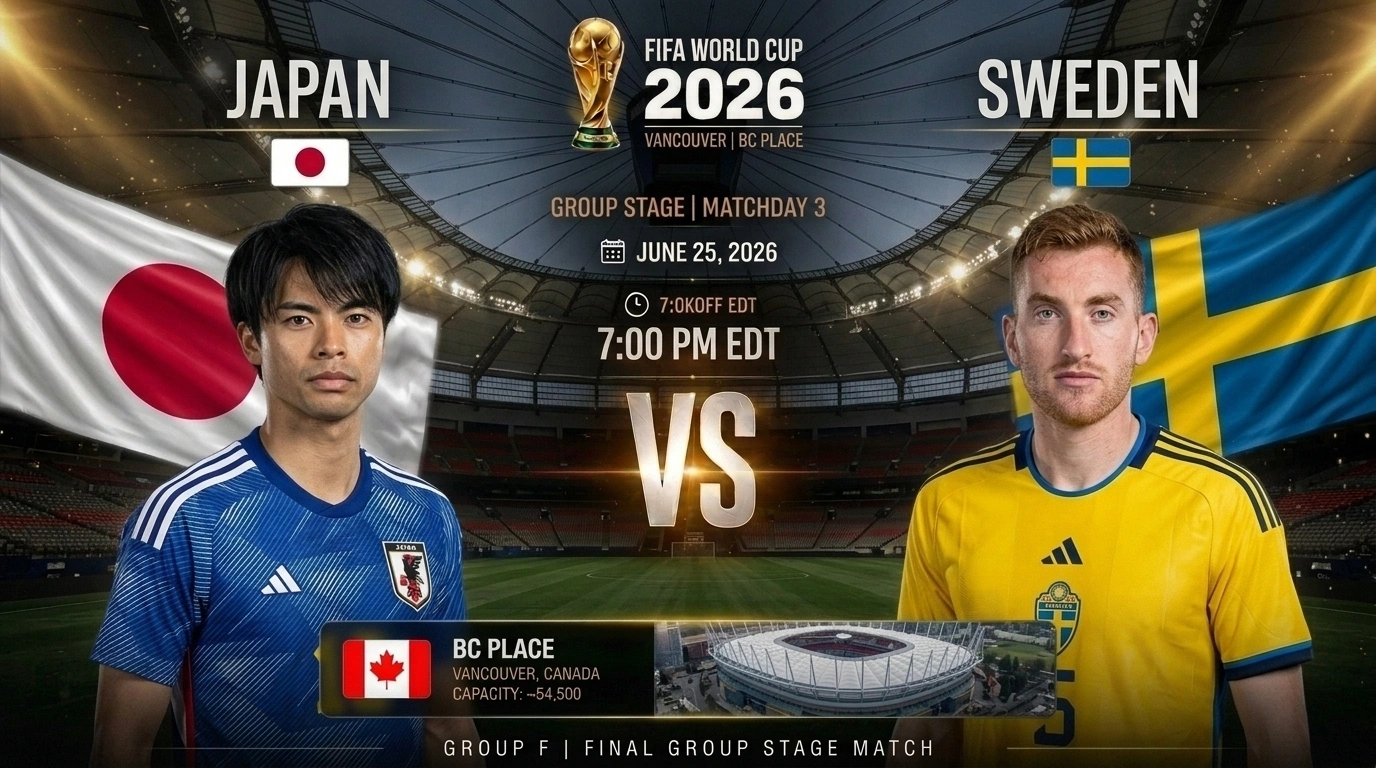
Japan vs Sweden kicks off at 7:00 PM EDT on June 25, 2026 at BC Place, Vancouver. It is the closing fixture in World Cup 2026 Group F, played simultaneously with Tunisia vs Netherlands.
The Japan vs Sweden prediction is shaped by one of the most interesting contradictions of the group stage. Japan have been consistent and tactically convincing across two very different tests. They drew 2-2 with the Netherlands in a match that showed their ability to live with elite technical quality, then produced one of the cleanest attacking performances of Matchday 2 by beating Tunisia 4-0.
Sweden have been far more volatile. Their opening 5-1 win over Tunisia made them look like a dangerous dark horse, especially because of their physical power and final-third efficiency. But the 5-1 defeat against the Netherlands completely changed the tone of their campaign. Sweden still have three points, yet the defensive damage from that result means they enter the final round with pressure on their structure, confidence and goal difference.
Japan sit on 4 points, level with the Netherlands but behind or alongside them depending on goal-difference calculations. Sweden have 3 points, which means they are still alive, but their safest route is a win. A draw may leave Sweden exposed to the third-place ranking, while a defeat would almost certainly put their knockout hopes under serious threat.
The key story is therefore not simply “technical team vs physical team.” It is a match between a Japan side that can qualify by staying composed and a Sweden side that must prove the Netherlands collapse was an accident rather than a warning sign.
Japan opened with a 2-2 draw against the Netherlands, showing they could survive against one of the strongest possession sides in the group. They then beat Tunisia 4-0, a result that confirmed both attacking rhythm and defensive maturity.
Sweden started superbly with a 5-1 win over Tunisia, but their Matchday 2 collapse in a 5-1 defeat to the Netherlands raised major questions about defensive spacing, recovery runs and resilience under sustained pressure.
Before the final round, the Group F picture is unusually sharp. The Netherlands and Japan both have 4 points. Sweden have 3 points. Tunisia are on 0 points and face the Netherlands in the other match. That means Japan are in a strong position but still cannot afford a loose ninety minutes.
Japan's motivation is twofold: qualify and avoid turning a strong group campaign into a nervous third-place calculation. A draw may be enough, but a win would remove uncertainty and could even put pressure on the Netherlands for first place. Because Japan's goal difference is strong after the Tunisia win, they do not need to chase the match recklessly.
Sweden's motivation is more urgent. Three points after two matches is not a disaster, but the heavy defeat to the Netherlands means goal difference is no longer a safety net. Sweden need to change the emotional tone of the tournament immediately. A win over Japan would likely send them through. A draw would leave them hoping that three points and a damaged goal difference are enough. A defeat could end the campaign.
This creates a fascinating tactical tension: Japan can be patient; Sweden may need to force moments earlier than they normally would.
Japan have quietly built one of the most coherent profiles in the tournament. Their 2-2 draw with the Netherlands was important because it showed they can handle long stretches without full control of the ball. They did not panic when pressed, they found ways to escape pressure through third-man combinations, and they remained dangerous when possession turned over.
The 4-0 win over Tunisia was a different kind of evidence. It showed Japan can also dominate a match they are expected to control. Their attacking shape looked fluid, with wide players stretching the pitch while central runners attacked the pockets between midfield and defence. Japan's best work comes when they move the ball quickly enough to pull opponents out of their defensive slots before accelerating into the half-spaces.
Against Sweden, Japan should not need to monopolise possession for long periods. Their advantage is more likely to come from tempo changes. Sweden's defensive collapse against the Netherlands exposed problems when the back line was forced to turn and defend repeated diagonal runs. Japan are exactly the type of team that can test that weakness through rotations, low crosses and quick combinations around the edge of the box.
The main concern for Japan is physical exposure. Sweden can be dangerous from set pieces, long diagonals and second balls. Japan's rest-defence must be disciplined, especially when both fullbacks advance. If Japan concede too many cheap fouls or allow Sweden to turn the match into a contest of aerial duels, the balance becomes less comfortable.
Read our full Japan team analysis for squad profile, tactical identity and World Cup 2026 outlook.
Sweden's tournament has been dramatic enough to make prediction difficult. The 5-1 win over Tunisia was not just a strong result; it suggested Sweden could hurt teams with directness, set-piece strength and efficient finishing. Their attacking profile looked uncomplicated but effective: win territory, attack early, put bodies into the box and punish hesitation.
The Netherlands match changed everything. Losing 5-1 exposed defensive issues that cannot be dismissed as a one-off unless Sweden respond quickly. The problem was not only the scoreline. It was the type of goals and the amount of space conceded between the lines. Once the Netherlands increased their circulation speed, Sweden struggled to protect the central channels and became vulnerable when forced to defend facing their own goal.
Against Japan, Sweden must decide whether to press aggressively or protect the back line. A high press could disrupt Japan's rhythm, but it also risks opening exactly the spaces Japan want to attack. A deeper block may keep the scoreline controlled, but it could hand Japan the territorial dominance they need to manage the match.
The best route for Sweden is probably selective aggression. They need to press Japan in wide zones, compete hard for second balls and use set pieces as a genuine weapon. But they cannot allow the game to become stretched too early. If Japan score first, Sweden may be forced into a chase that suits Japan's transition game.
Explore our Sweden team profile for detailed squad analysis and tournament outlook.
Editorial comparison based on the first two Group F matches.
| Factor | Japan | Sweden | Edge |
|---|---|---|---|
| Group position | 4 points, strong goal difference | 3 points, goal difference damaged by Netherlands defeat | Japan |
| Recent results | 2-2 Netherlands, 4-0 Tunisia | 5-1 Tunisia, 1-5 Netherlands | Japan |
| Attacking rhythm | Fluid combinations and strong chance creation | Direct and dangerous but less stable | Japan |
| Physical power | Technically sharp but less dominant aerially | Strong in duels, crosses and set pieces | Sweden |
| Defensive stability | Better structure across both matches | Concern after conceding five to Netherlands | Japan |
| Set pieces | Organised but not their main weapon | Major route to goal | Sweden |
| Game-state pressure | Can qualify with control | Likely needs a result and maybe a win | Japan |
Japan should look to pull Sweden's midfield out of shape with short combinations and third-man runs. The key is not just possession volume, but how quickly Japan can turn circulation into penetration.
Sweden's clearest path is direct pressure: crosses, set pieces, second balls and early balls into the channels. They need to make the game physically uncomfortable without losing defensive spacing.
If Sweden commit numbers forward, Japan can punish the space behind the fullbacks. Japan's counterattacks may become more dangerous as Sweden's urgency increases.
Sweden cannot press blindly. Japan are too good at escaping pressure. Selective pressing near the touchline is safer than opening central gaps with a full high press.
A Japan opener would force Sweden into a risky chase. A Sweden opener would completely change the emotional balance and test Japan's patience under real knockout pressure.
Japan can approach the match with more control. Sweden's situation is more urgent after the heavy defeat against the Netherlands.
Japan's ability to accelerate after patient possession could expose Sweden's defensive gaps between midfield and defence.
Sweden can still turn this match through corners, free-kicks and aerial dominance. Japan must defend dead-ball situations with discipline.
BC Place, Vancouver on June 25, 2026 — kick-off at 7:00 PM EDT.
4-2-3-1 / 4-3-3
Japan should build patiently, use wide rotations and attack the half-spaces when Sweden's midfield line shifts.
4-4-2 / 4-2-3-1
Sweden are likely to mix compact defending with direct attacks, set-piece pressure and crosses into the penalty area.
Japan Win or Draw
Japan 2-1 Sweden
Best Value Pick: Japan Double Chance & Over 1.5 Goals
Confidence Level: Medium
Japan look like the more balanced side. Their tournament has shown both resilience against elite opposition and the ability to dominate a weaker opponent. Sweden remain dangerous because of physical power and set pieces, but the defensive collapse against the Netherlands is difficult to ignore. Expect Sweden to create pressure in phases, especially from wide deliveries, yet Japan's speed of combination and better game-state control should give them the edge. The most realistic forecast is a competitive match with chances at both ends, but Japan are better placed to manage the decisive moments.
Japan are slight favourites because they have four points, better recent form and a more stable tactical profile. Sweden remain dangerous, but their 5-1 defeat to the Netherlands raises defensive concerns.
Our exact score prediction is Japan 2-1 Sweden. Japan's combination play should create chances, but Sweden's set-piece threat makes a clean sheet difficult.
Japan drew 2-2 with the Netherlands and then beat Tunisia 4-0, giving them four points before Matchday 3.
Sweden beat Tunisia 5-1 in their opener but lost 5-1 to the Netherlands on Matchday 2.
Our editorial best value pick is Japan Double Chance & Over 1.5 Goals. This is analysis, not betting advice.
The match is scheduled for June 25, 2026 at BC Place, Vancouver, with kick-off at 7:00 PM EDT.