

Goal Difference Advantage
Austria’s superior goal difference means a draw can be enough for second place, changing their risk tolerance.
World Cup 2026 Matchday 3 — Final Group Stage Match
 Algeria
 Austria
Algeria vs Austria is a direct Group J shoot-out for second place at Arrowhead Stadium, Kansas City. Both teams enter the final matchday on three points, Argentina have already secured top spot, and Jordan have been eliminated. Austria hold the advantage on goal difference, while Algeria need a more proactive result to guarantee second place. This full preview covers the tactical matchup, current form, key battles, betting angles and exact score prediction.
Editorial Win Probability
Editorial estimate based on Group J standings, squad quality, tactical matchup and expected game state. Not betting odds.
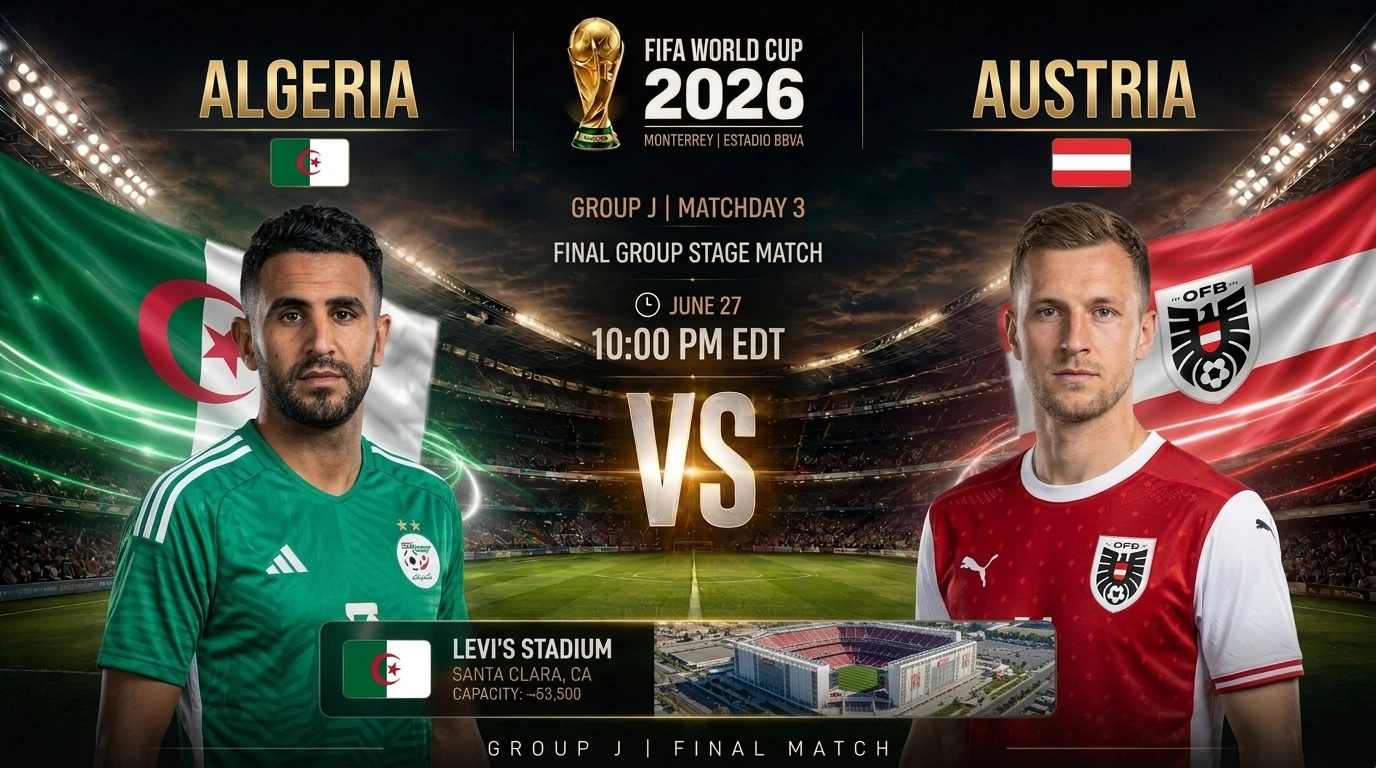
Algeria vs Austria kicks off at 10:00 PM EDT on June 27, 2026 in Group J at Arrowhead Stadium, Kansas City. This is one of the clearest qualification deciders of Matchday 3: Austria and Algeria are level on points, Austria are ahead on goal difference, and the winner guarantees progression to the round of 32.
The Algeria vs Austria match is a direct tactical and psychological test. Argentina have already secured first place in Group J, while Jordan have been eliminated, so the focus is on second place and the third-place ranking. Austria and Algeria both have three points, but Austria’s superior goal difference gives Ralf Rangnick’s side a slightly more comfortable game state. A draw can be enough for Austria to finish second, while Algeria are likely to need a win to guarantee that position.
This creates a difficult strategic question for both coaches. Austria can manage risk, but becoming too passive would invite Algeria’s wide players and set-piece threat into the match. Algeria can chase second place, but opening the pitch too early would expose them to Austria’s pressing traps, direct vertical attacks and aggressive midfield runners.
There is also historical edge. Algeria and Austria are connected by the 1982 World Cup “Disgrace of Gijon” storyline, when Algeria were eliminated after a controversial Austria-West Germany result. The modern match is obviously a different football context, but the narrative adds emotional weight to an already decisive fixture.
From an SEO and football analytics perspective, this fixture has everything: qualification stakes, tactical contrast, group-stage pressure, knockout implications and major betting-market uncertainty. The most realistic expectation is not a wide-open game. It is a controlled, tense, low-margin contest where the first goal changes the entire tactical script.
Group J is almost perfectly set up for a final-matchday decider. Argentina are already safe at the top, Jordan have no points and are eliminated, and Algeria and Austria are fighting for the second automatic qualification place. Reuters described it as a straight shoot-out for second place, with both teams on three points and Austria ahead on goal difference.
That standings situation gives Austria slightly more control. They do not need to force the match from minute one. Rangnick’s side can press in phases, protect central spaces and look for moments when Algeria’s build-up becomes loose. Algeria, however, cannot simply wait forever. Vladimir Petkovic’s team need attacking ambition, but that ambition has to be measured. If Algeria chase emotionally, Austria can punish them with quick central combinations and vertical runs.
The third-place qualification system also complicates the game. A draw may help both sides in the wider tournament picture, but it carries different implications for route planning. Second place could mean a more difficult round-of-32 opponent, while third place may lead to a different bracket. That does not mean either side will deliberately avoid winning, but it does make the late-game incentives more nuanced if the score is level after 70 minutes.
See our World Cup 2026 predictions hub and group overview for the wider tournament picture.
Algeria enter this fixture with the stronger need to win, but also with enough attacking quality to hurt Austria if they manage the game intelligently. Algeria’s strength is not only individual flair. It is the ability to combine direct wide attacks, aggressive midfield duels and set-piece pressure into a match plan that can disrupt technically organised opponents.
Riyad Mahrez remains the symbolic and creative reference point. His ability to slow the game, draw defenders and deliver from wide areas can be decisive. Algeria also need movement around him: midfield runners, overlapping fullbacks and penalty-box presence. If Mahrez receives the ball while isolated and Austria can double-team him without consequence, Algeria’s attack will become predictable.
The major question is Mohamed Amoura’s availability. Reuters noted that Amoura was doubtful, which matters because he gives Algeria speed, directness and pressing energy. If he is unavailable or limited, Algeria may need a more patient attacking structure and stronger set-piece efficiency.
Defensively, Algeria must resist the temptation to press recklessly. Austria are comfortable when opponents jump out of shape. Algeria need compact distances between midfield and defence, with quick pressure on Austria’s first forward pass but no uncontrolled chasing. The best Algerian version in this match is emotional but disciplined: aggressive in duels, calm in possession and clinical on set pieces.
Read our Algeria team analysis for squad depth, key players and tournament outlook.
Austria are one of the most tactically recognisable teams in this group. Under Ralf Rangnick, Austria rely on compact pressing, verticality, counter-pressing and coordinated midfield pressure. They do not need long possession spells to control matches. They control matches by forcing opponents into bad decisions.
Their advantage against Algeria is structural. Austria are comfortable defending forward, pressing triggers and attacking quickly after recoveries. If Algeria attempt to build through central zones under pressure, Austria can turn those moments into dangerous attacks. Marcel Sabitzer’s timing, Christoph Baumgartner’s movement and Konrad Laimer’s intensity give Austria a strong midfield platform.
Austria also have the psychological benefit of goal difference. They can play with slightly less desperation than Algeria. However, that benefit can become a trap. If Austria sit too deep or try only to protect the draw, they will invite pressure and reduce their own strongest weapon: aggressive midfield disruption.
The injury context is important too. Reuters reported Stefan Posch played with a broken jaw against Argentina, which underlines Austria’s resilience but also creates a possible defensive concern. Algeria will likely test Austria’s right side and force physical wide duels to see whether Austria’s back line can handle repeated pressure.
Explore our Austria team profile for detailed squad analysis ahead of this fixture.
Current Group J form and performance trends before the final matchday.
Algeria’s campaign has been defined by competitiveness and pressure. They have enough quality to beat Jordan and enough defensive organisation to remain competitive in the group, but their defeat to Argentina means they enter Matchday 3 needing a cleaner, more complete performance. Algeria cannot rely only on moments from Mahrez or set pieces; they need sustained tactical clarity.
The positive sign is that Algeria have a direct route to winning this match: wide progression, physical midfield pressure and attacking transitions. The concern is whether they can maintain composure if Austria’s press disrupts their rhythm. Algeria’s ability to play through the first wave of pressure may decide whether they create real chances or simply defend long periods without control.
Austria’s group form is functional and disciplined. They beat Jordan, lost to Argentina and enter the final matchday with the advantage over Algeria on goal difference. That means Austria have been efficient enough to put themselves in a favourable position, even if they are not entering as a dominant attacking side.
Their strongest form indicator is tactical identity. Austria know what they are: pressing, vertical, compact and hard to play through. Their weakness is that high pressing can leave space if the timing is wrong. Algeria’s wide quality means Austria must press with coordination, not emotion.
Editorial comparison based on squad balance, tactical style, Group J context and expected match dynamics.
| Factor | Algeria | Austria | Edge |
|---|---|---|---|
| Group position | Three points; likely need win to guarantee second place | Three points; better goal difference makes draw more useful | Austria |
| Squad depth | Strong core, creative wide players, but injury questions matter | More stable tactical depth and strong midfield rotation | Austria |
| Attacking threat | Mahrez creativity, wide attacks, set pieces and transition threat | Vertical runs, midfield arrivals and pressing-generated chances | Even |
| Defensive stability | Compact when disciplined, vulnerable if they chase too early | Organised pressing system but can leave space behind pressure | Even |
| Midfield control | Physical and direct, but can be rushed under pressure | Better pressing structure and clearer central automatisms | Austria |
| Set pieces | Dangerous delivery and aerial targets | Strong organisation and second-ball pressure | Even |
| Transition threat | Dangerous if Austria’s press is bypassed | Excellent at turning recoveries into attacks | Austria |
| Pressure management | Need proactive result; emotional stakes are high | Can manage draw scenario more comfortably | Austria |
Algeria need controlled build-up, but not sterile possession. Austria will try to press the first pass into midfield and force rushed decisions. Algeria’s best route is to circulate quickly toward wide areas, use Mahrez as a connector and avoid losing the ball centrally.
Austria’s pressing triggers are clear: backward passes, poor first touches and square balls near the touchline. Algeria should press more selectively, targeting Austria’s fullbacks and preventing easy vertical passes into midfield runners.
Transitions may decide the match. If Austria press high and Algeria break the first line, Algeria can attack space quickly. If Algeria lose the ball in midfield, Austria can create immediate danger through Sabitzer, Baumgartner and Laimer’s forward running.
Algeria’s best attacking route is likely wide. Mahrez can draw pressure and create delivery angles, while Austria will try to trap Algeria near the sideline. The quality of Algeria’s support runs will decide whether wide attacks become chances or dead ends.
Set pieces have major value because the open-play margin is narrow. Algeria have delivery and aerial presence, while Austria are strong on second balls. One corner or free-kick could decide second place in Group J.
Austria’s superior goal difference means a draw can be enough for second place, changing their risk tolerance.
Algeria need ambition, but chasing too early could expose them to Austria’s pressing and transition game.
If Austria win the ball high, they can create chances before Algeria’s defensive block resets.
An Algeria goal forces Austria to open up. An Austria goal puts Algeria in a difficult emotional chase.
Algeria need Mahrez to create separation, draw fouls and produce high-quality delivery from wide areas.
Austria’s midfield runners can attack gaps if Algeria’s defensive line drops too deep or loses tracking.
Expected shape: 4-2-3-1 / 4-3-3
Algeria should combine compact defending with controlled attacking ambition. Their best moments should come through Mahrez, wide overloads, set pieces and quick transitions after Austria commit midfielders forward.
Expected shape: 4-2-3-1 / 4-4-2 press
Austria are expected to press in coordinated phases, keep distances compact and attack quickly after recoveries. Their draw advantage may make them slightly more cautious after halftime if the score remains level.
Our Algeria vs Austria prediction leans toward a draw. Austria have the slightly better structural position because goal difference gives them more flexibility, and their pressing identity can make Algeria uncomfortable. Algeria have enough quality to win, especially if Mahrez controls the wide rhythm and set pieces become decisive, but they must balance ambition with defensive discipline.
The match projects as low-margin because neither side benefits from reckless football. Austria can qualify with a draw-related game state, while Algeria know that conceding first would make the task far more complicated. That creates a strong under 2.5 goals profile, especially if the opening 30 minutes stay level.
The most likely exact score is Algeria 1-1 Austria. Austria’s draw advantage makes them slightly more comfortable in the late phase, while Algeria’s attacking urgency should still be enough to create at least one major scoring spell.
Algeria 1-1 Austria
Algeria 1-1 Austria
Best Value Pick: Under 2.5 Goals
Secondary Angle: Draw
Alternative Market: Austria +0.5
Confidence Level: Medium
This Algeria vs Austria prediction is based on Group J standings, Austria’s goal-difference advantage, Algeria’s need for attacking ambition and the tactical likelihood of a compact final group-stage match.
This is the strongest angle. The match has qualification pressure, Austria’s draw advantage and Algeria’s need to avoid conceding first. All of that supports a controlled, low-scoring game.
The draw has strong tactical logic because Austria can benefit from it and Algeria may still have third-place protection depending on the wider ranking table.
Austria’s structure, pressing and goal-difference position make them difficult to beat. This is safer than a straight Austria win.
BTTS is possible if Algeria’s attacking pressure grows and Austria’s transitions remain dangerous, but it is less safe than under 2.5 because a 0-0 or 1-0 game is realistic.
Both teams have enough dead-ball quality for a set-piece chance to decide the match. Corners and wide free-kicks should carry higher value than usual.
Mahrez is Algeria’s main creator. Austria must prevent him from receiving with time to face goal, while Algeria need support runs so Mahrez is not trapped near the touchline.
Sabitzer’s timing and forward passing can break Algeria’s defensive spacing. Algeria must close him quickly without opening gaps behind midfield.
Austria will try to press Algeria near the sideline. Algeria’s fullbacks need clean first touches and passing options to avoid turnovers in dangerous areas.
Baumgartner can find space between Algeria’s midfield and back line. Tracking his movement is essential, especially when Austria transition quickly.
Algeria’s delivery and Austria’s second-ball aggression make dead balls a major tactical phase. Defensive concentration will be decisive.
If Mohamed Amoura is unavailable or limited, Algeria lose speed and pressing energy. That could reduce their transition threat and make the match more dependent on Mahrez and set pieces.
Austria can benefit from a draw, but sitting too deep would invite Algeria pressure. Their best defensive tool is still coordinated pressing, not passive protection.
An early goal could break the low-scoring model. Algeria scoring first would force Austria forward, while Austria scoring first would push Algeria into a more open chase.
The 48-team format changes late-game incentives. If a draw looks useful for both sides, the final 15 minutes may become cautious rather than aggressive.
Algeria vs Austria is scheduled for June 27, 2026 at 10:00 PM EDT at Arrowhead Stadium, Kansas City.
This fixture is in Group J of the FIFA World Cup 2026.
Our editorial prediction is Algeria 1-1 Austria.
Under 2.5 Goals is the strongest value angle because the match profile is tactical, cautious and qualification-driven.
Yes. A win guarantees Algeria a place in the round of 32 and likely second place in Group J.
Yes. Austria’s superior goal difference means a draw is expected to be enough for second place.
Riyad Mahrez is Algeria’s key player because of his creativity, delivery and ability to control attacks from wide areas.
Marcel Sabitzer is crucial because Austria need his pressing, timing and final-third decision-making.
No. The tactical profile points toward a low-scoring match, with 0-0, 1-1, 1-0 or 0-1 all realistic.
It is a direct battle for second place in Group J, with both teams on three points entering the final matchday.
You can read more previews on our World Cup 2026 predictions hub.