
Venue & Atmosphere
Neutral venue conditions reduce any true home advantage, so the match should be decided more by structure, pressing quality and execution than by atmosphere alone.
(World Cup 2026)
Austria
Jordan
Austria vs Jordan prediction with tactical analysis, FIFA ranking context, recent form comparison, key players and score projection for this Group J fixture at Levi's Stadium, Santa Clara.
Editorial Win Probability
Editorial probability estimate, not betting odds.
Our Austria vs Jordan Prediction examines a Group J fixture at Levi's Stadium, Santa Clara — a match Austria should approach as a clear opportunity to establish early control in the group. FIFA ranking context and recent form both point toward Austria as the stronger side, while Jordan's route to a result depends on defensive discipline, transition speed and set-piece efficiency.
Recent form indicators combined with official FIFA ranking context.
| Metric | Austria | Jordan |
|---|---|---|
| FIFA Ranking | 24 | 64 |
| Last 5 Record | 4W · 1D · 0L | 0W · 2D · 3L |
| Goals Scored (last 5) | 2.0 per game | 1.4 per game |
| Goals Conceded (last 5) | 0.4 per game | 2.6 per game |
| Clean Sheets (last 5) | 60% | 0% |
| Qualification Record | UEFA qualifiers | AFC qualifiers |
Recent-results data from Flashscore. FIFA ranking context checked against official FIFA ranking pages. Not betting data.
Austria enter this Group J match with the stronger tournament profile. FIFA lists Austria inside the top 25 of the men's ranking, while Jordan sit much lower in the same ranking system. That gap does not decide the match on its own, but it gives useful context: Austria should have more control phases, more pressing quality and a higher baseline level across midfield and attack.
Jordan's story is different. FIFA describe Jordan's 2026 qualification as a historic first World Cup appearance, which makes this fixture emotionally significant but also tactically demanding. Against a European opponent with stronger structure, Jordan cannot afford long stretches of passive defending or loose build-up mistakes near their own box.
The likely match pattern is Austria pressing high, recovering second balls and forcing Jordan into longer clearances. Jordan's best moments should come from direct attacks into wide channels and dead-ball situations, but over 90 minutes Austria's collective organisation makes them the more reliable prediction.
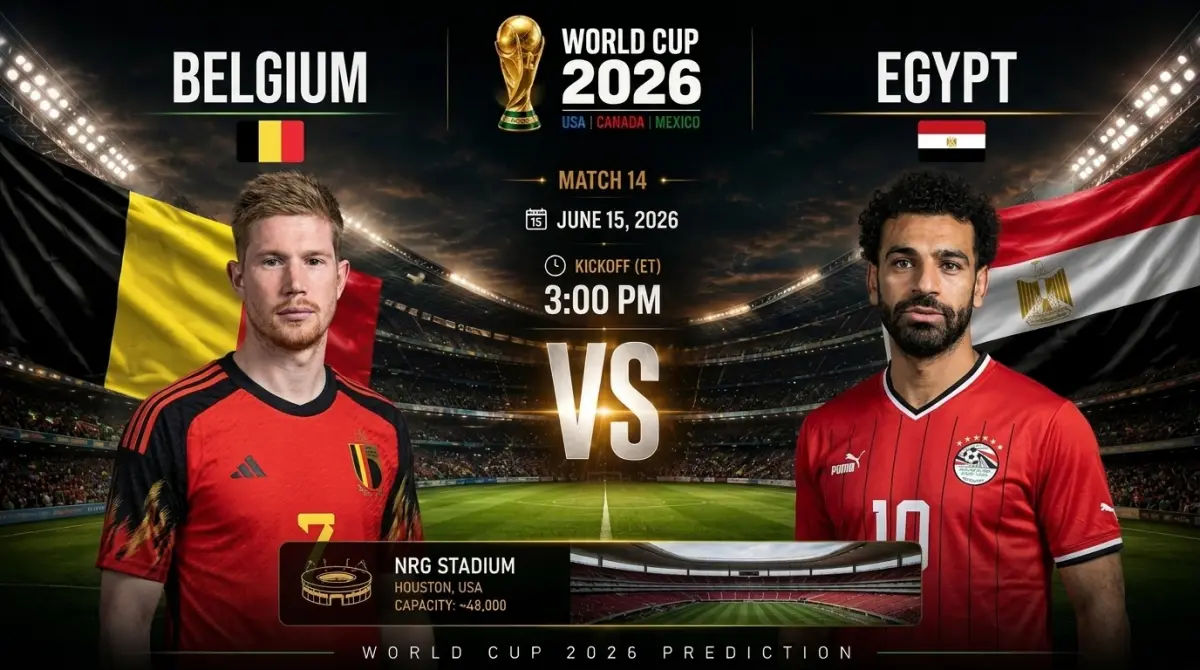
Belgium arrive at World Cup 2026 in a transitional but still highly competitive phase. The peak years of the so-called golden generation have passed, yet the squad remains strong enough to control matches against most opponents outside the elite tier. The key difference compared with previous Belgian teams is that the structure now matters more than reputation: Belgium need collective pressing, compact rest-defence and sharper attacking spacing to turn individual quality into tournament results.
Kevin De Bruyne remains central to Belgium's attacking rhythm. His passing range can change the speed of the game in one action, especially when Belgium pull Egypt's midfield across the pitch and then find runners between fullback and centre-back. Jeremy Doku is the natural wide disorganiser, able to attack one-v-one situations and force Egypt into emergency cover. Romelu Lukaku gives Belgium a direct target in the box and a reliable reference point when crosses, cut-backs or second balls become the main source of pressure.
Belgium's biggest advantage in this match should be midfield control. If they circulate the ball with patience but avoid sterile possession, Egypt will have to defend for long stretches. The danger is the space left behind attacking fullbacks and advanced midfielders. Egypt's forwards are quick enough to punish slow counter-pressing, so Belgium cannot treat this as a simple possession exercise.
For Belgium, the ideal scenario is an early goal that forces Egypt to open up. If the match stays goalless for too long, the psychological balance becomes less comfortable and Egypt's belief grows. That is why Belgium's first-half tempo, shot quality and set-piece delivery are decisive in this prediction.
Egypt enter this World Cup fixture with a clear identity: compact without the ball, direct after regains and heavily influenced by the quality of their attacking leaders. They are not expected to control the ball against Belgium, but Egypt can make the match difficult if they protect central spaces and keep their forward outlets connected to the rest of the team.
Mohamed Salah is the obvious reference point. Even when Egypt spend long spells defending, Salah changes the opponent's risk calculation because one early pass into the right channel can create a major chance. Omar Marmoush gives Egypt another layer of speed and directness, especially when he can attack space before Belgium reset their defensive shape. If both players are isolated and forced to receive with their backs to goal, Egypt's upset route becomes much narrower.
Defensively, Egypt need discipline more than aggression. Belgium are capable of creating overloads wide and finding De Bruyne between the lines, so Egypt's midfield distances have to stay tight. The centre-backs must also deal with Lukaku's physical presence without giving away cheap free kicks around the box.
Egypt's best scenario is a low-event first half, limited Belgian shot quality and one or two fast transitions that remind Belgium they cannot overcommit. If Egypt score first, the match becomes a very different tactical problem. If they concede early, they may be forced into a more open game that suits Belgium's stronger squad depth.
Editorial assessment across seven key match factors.
| Factor | Austria | Jordan | Edge |
|---|---|---|---|
| World Cup experience | Returning World Cup side with stronger UEFA-level competition rhythm | First World Cup campaign; less experience at this level | Austria |
| Squad depth | Greater depth across midfield, pressing roles and attacking rotations | Clear core but less depth against high-tempo European opposition | Austria |
| Attacking threat | Pressing recoveries, wide combinations and central runners | Best threat comes from counters, wide breaks and set pieces | Austria |
| Defensive stability | Strong recent defensive trend and compact rest-defence | Can defend deep but recent concession numbers are a concern | Austria |
| Midfield control | Better ball retention and passing range under pressure | Compact midfield; most dangerous after regains | Austria |
| Set pieces | Aggressive delivery, second-ball pressure and aerial targets | Useful delivery and physical presence, but defensive pressure is higher | Even |
| Pressure factor | Expectation to start Group G with control and authority | Less pressure and clearer underdog game plan | Jordan |
Austria should control the ball through structured midfield circulation rather than slow sterile possession. The key will be moving Jordan's block from side to side, then attacking the half-spaces before Jordan can reset their defensive line.
Austria's biggest edge is intensity without the ball. If they press Jordan's first pass and win second balls around midfield, they can keep the match in Jordan's half and create chances before the underdogs settle into a compact shape.
Jordan's best route to goal is early vertical play after Austria lose possession. That means Austria's rest-defence matters: the fullbacks can push forward, but the holding midfielders must protect central counter-attacking lanes.
Austria should look to create overloads wide, especially when Jordan's wingers are forced deep. If Austria can isolate the far-side fullback after quick switches, Jordan may struggle to defend crosses and cut-backs consistently.
Set pieces are Jordan's most realistic equaliser if open-play chance volume stays low. Austria still hold the advantage here because pressure, territory and repeated wide entries should give them more corners and free-kick opportunities.
Austria arrive unbeaten across their last five internationals (4W, 1D), including wins over Tunisia, South Korea and Ghana plus draws with Bosnia & Herzegovina. They have been productive in attack (2.0 goals per game) and solid defensively, with 3 clean sheets in that span.
Jordan are winless in their last five (0W, 2D, 3L), including draws with Nigeria and Costa Rica plus losses to Colombia, Switzerland and Morocco. They have been limited in front of goal (1.4 goals per game) and vulnerable at the back, with no clean sheets in that span.
Austria's central creator should be decisive between Jordan's midfield and defensive lines. The key role is receiving on the half-turn, combining quickly and forcing Jordan's centre-backs to step out of their compact block.
Austria's midfield anchor must control the spaces behind the press. His positioning after turnovers will decide whether Jordan can break into open grass or are forced backward into another defensive phase.
Jordan's most dangerous outlet will be the first forward runner after regains. If he can attack the space behind Austria's advanced fullbacks, Jordan can create isolated moments even without sustained possession.
Jordan's defensive leader will need to manage the penalty area under repeated pressure. Clear communication, first-contact defending and avoiding cheap fouls around the box are essential if Jordan want to keep the match close.
Austria could win because their strengths align directly with Jordan's current vulnerabilities. Austria's recent results show strong defensive control and efficient chance conversion, while Jordan's last-five profile shows no clean sheets and a high concession rate.
Austria should also have the tools to win territory quickly through pressing and wide overloads. If Jordan defend deep for long periods, Austria's set-piece volume and second-ball pressure should create enough chances to justify their favourite status.
Jordan can cause problems if they turn the match into a low-event contest. Their path is not long spells of possession; it is compact defending, fast first passes after regain and using wide runners before Austria's counter-press locks the game down.
The danger for Austria is emotional impatience. If the match stays level past the opening hour, Jordan's confidence will grow and set pieces become more important. Still, Jordan need a very clean defensive performance to make that scenario realistic.
Neutral venue conditions reduce any true home advantage, so the match should be decided more by structure, pressing quality and execution than by atmosphere alone.
Austria are returning to the World Cup stage with a strong UEFA qualification profile, while Jordan are entering their first tournament. Managing the first 20 minutes will be crucial for both.
Jordan's clearest route to an upset is transition efficiency. They may not create many chances, so the first clean break or set-piece delivery has to be executed sharply.
If Austria score first, the tactical picture strongly favours them. If Jordan reach halftime level, the match could become tighter and more dependent on set pieces.
4-3-3 / 4-2-3-1
Austria are expected to use an aggressive 4-2-3-1 or 4-3-3, with compact distances between midfield and attack. The aim should be to press high, recover second balls and keep Jordan defending near their own box.
4-2-3-1 / compact 4-4-2
Jordan are likely to defend in a compact 4-4-2 or 4-2-3-1 block. Their attacking shape should be direct, with early passes into wide runners and limited risk in central build-up.
Austria win
Confidence: Medium–High
This Austria vs Jordan Prediction favours Austria because the matchup points in the same direction across several categories: FIFA ranking position, recent form, defensive trend, midfield quality and pressing structure. Austria do not need to dominate spectacularly to justify the prediction; they need to control territory, prevent Jordan's counters and convert one of the repeated pressure phases into a goal. Jordan's upset route is clear but narrow. They need a disciplined low block, strong first-contact defending and one or two efficient attacking transitions. If they concede early, the game state becomes difficult because Austria are better equipped to manage possession and force the match into Jordan's half. The most realistic score range is Austria 1-0 to 2-1, with 2-0 also possible if Austria's press creates enough second-half chances.
Belgium are the favourite because they have a stronger squad profile, more reliable midfield control and several elite attacking options. Egypt are dangerous in transition, but Belgium should create more chances across the match.
Our predicted score is Belgium 2-1 Egypt. Belgium are expected to control more territory and generate more pressure, while Egypt have enough quality through Mohamed Salah and Omar Marmoush to threaten on the break.
Yes, Egypt can upset Belgium if they keep the match compact, defend the penalty area well and convert one of their transition moments. Their upset route depends on efficiency rather than possession dominance.
Belgium vs Egypt is scheduled for Seattle Stadium in Seattle as part of FIFA World Cup 2026 Group G.
No. This page provides editorial football analysis and probability estimates. It is not betting advice and the percentages shown are not bookmaker odds.